Tuesday, July 31, 2007

rAiz'n Ensemble Program

AUDITIONS

for

rAiz’n ensemble program

by

b current

Thursday, August 23, 2007 at 1:00-5:00 pm

Call Back: Saturday, August 25, 2007 1:00 – 4:00 pm

Maria A. Shchuka Library

The rAiz’n ensemble is an established component of the company’s wider rAiz’n the sun training program. Now in its 9th season, the rAiz’n ensemble program enters a new 3 year-cycle in September 2007, and runs until August of each season. Auditions for entry into the program this season are now open.

During the course of the program, ensemble members will participate in part-time workshop series and classes, customized apprenticeships, mentoring, networking opportunities, peer collaboration, and hands-on work in the company’s productions, including the annual rock.paper.sistahz festival.

The program is for career-oriented individuals with interests in performance, creation, design, writing, directing, and/or producing, who are looking to continue honing their craft and accessing a direct springboard into the work arena.

Facilitators and mentors who work with the rAiz’n ensemble are professional artists, alongside the program lead, b current’s Artistic Director, ahdri zhina mandiela.

Booking a slot in the audition can be made by calling 416-533-1500. For the initial audition on August 23, applicants are required to present any kind of performance piece (2 – 5 minutes) and/ or present a work activities portfolio. Applicants selected for call back will engage in a workshop session on August 25.

For more information, please contact:

Chiaki Nemoto

General Manager, b current

720 Bathurst Street, Suite 402, Toronto, ON M5S 2R4

Tel: 416-533-1500

Fax: 416-533-1560

Cell: 647-839-3332

E-mail: gm@bcurrent.ca

Website: www.bcurrent.ca

Saturday, July 21, 2007

ALAMEDA THEATRE COMPANY: An Avenue for Latin Voices

2007-2008
CALL FOR SUBMISSIONS
1ST ANNUAL
2008 DE COLORES FESTIVAL OF NEW WORKS BY LATIN-CANADIAN PLAYWRIGHTS

Alameda Theatre Company, Canada's premiere professional Latin Canadian theatre company, invites submissions from established and emerging playwrights for our first ever Latin Canadian playwright’s festival: THE 2008 DE COLORES FESTIVAL OF NEW WORKS.

The festival will focus on providing developmental support for works in progress by pairing the chosen playwrights with professional dramaturgs from Toronto’s theatre community. This year’s festival dramaturgs are the award- winning director and playwright Guillermo Verdecchia (Bloom, The Noam Chomsky Lectures, Insomnia, Fronteras Americanas to name a few) and Stephen Colella, Dramaturg at Lorraine Kimsa Theatre for Young People.

Our mandate is to provide opportunities to Latin Canadian theatre artists and playwrights and to build audiences for their work. We envision that Latin American arts and artists will be embraced by a broad Canadian community that is aware of, understands and respects the Latin-American Canadian experience.

Scripts selected for the 2008 De Colores Festival of New Works will receive dramaturgical sessions from January to June 2008, a short workshop and staged reading in June 2008 and will automatically be short-listed for production in our upcoming seasons. Selected playwrights will be contacted by December 2007.

Deadline for submissions: October 15, 2007

GUIDELINES:
1. Scripts must be Canadian, original, un-produced works of 60 to 120 minutes in length.
2. Playwrights must be citizens or landed immigrants of Canada.
3. We will NOT accept more than one submission per playwright.
4. All themes are encouraged. Plays need not have specific Latin American themes or characters, but playwrights must be of Latin American origin, as the goal with this festival is to develop Latin American voices in Canada. (Even if you do not speak any Spanish, if you identify yourself as Latin American, Hispanic, Latino, Spanish or a mix of these, we encourage your submission.)
5. Cast size should preferably be no more than 5 characters.
6. All plays must be in English OR translated into English before the start of the festival.
7. Please include a one-page synopsis with the theme, plot, length of play, character breakdowns and any doubling possibilities.
8. Please also include a title page, with playwright’s name, name of play and contact information.
9. Submissions must be in hard copy only (emails will NOT be accepted), typed or word-processed, one side, loose page and minimum 11-point font on white paper. All pages must be numbered with the title of the play on each page.
10. Please do not submit original copies. If you wish to have your scripts returned, please include a SASE with the correct postage.

Please note:
Playwrights whose scripts are selected are encouraged to attend the festival in June. An honorarium will be provided to writers for the playwright unit and festival, however travel is the responsibility of the artist.

Please submit scripts to:
2008 De Colores Festival of New Works
ALAMEDA THEATRE COMPANY
966A Dundas St. W.
Toronto, Ontario
M6J 1W5

For more information regarding the 2008 De Colores Festival of New Works please email hola@alamedatheatre.com or call (416) 428-7638.

Friday, July 06, 2007

Justice for Burma’s Students: 45 Anniversary of July 7th Commemoration

On March 2nd , 1962, the dictator Nay Win and his military generals took over power from the elected representatives of Burma. This coup provoked the first well-known vigorous student uprising against the dictatorship.

On July 7th, over 300 courageous student activists were killed as the students’ union building was demolished by dynamites. In addition, over 200 student demonstrators were gunned down inside the Rangoon University campus. Although the massacre occurred 45 years ago, the spirit for justice and democracy has lived on.

Here in Toronto, the Burmese Students’ Democratic Organization - Canada (BSDO) is holding an event to commemorate the 45th anniversary of July 7th massacre.

Special guest speaker - Mehn Robert Ba Zan

Mehn Robert Ba Zan was a 1962 student activist, and has taken a leader of the Karen National Union. He is also a leader of Karen communities in North America, based in Minnesota, working in support of community development and democracy movement for Burma.

There will also be host speakers from Toronto. We will sing revolution songs and play traditional live music with powerful drums. Everyone is welcome.

Time: 7 pm on Saturday, July 7th, 2007
Location: Burmese Python’s Soccer Club
430 St. Clarens Avenue
Toronto, Ontario

Space limited, first come first serve basis
Foods and refreshment provided

Free Admission

Contact information at 416-533-1906

Friday, June 29, 2007

OneLight Theatre Auditions

OneLight Theatre is auditioning women for its new play, The Veil, which tells the story of Khanoom, a Persian princess who journeys from Iran to Europe and back and experiences 20th century history from a unique vantage point.

There is one part available for a woman between 20 and 30 years old; strong skills in voice and movement are essential. The actor must be available from October 1 to December 10 and must be able to rehearse and perform in Halifax and Toronto.
Please send resume and head shot to:

Attention: Artistic Director, Shahin Sayadi
PO Box 1603
Halifax CRO
B3J 2Y3
The Veil is a OneLight Theatre production in association with Mermaid Theatre of Nova Scotia, Neptune Theatre and Harbourfront Centre.

OneLight Theatre contracts artists under the Canadian Theatre Agreement.

Thursday, May 03, 2007

AUDITION NOTICE

AUDITION NOTICE

A.C.T. Productions is holding auditions for its upcoming production of ‘R&J: Brampton’. The play is set in Brampton, based on the Shakespeare classic; this new adaptation is a comedy that speaks to the cultural differences in modern society. Rehearsals start June 18; performances are in late July at the Rose in Brampton.

Director Peter van Wart and playwrights David Carley & Glenda MacFarlane are seeking a diverse cast.

Audition Date: Friday May 11
Location: Rose Theatre Studio
1 Theatre Lane
Brampton
Times: 10am-2pm
Requirements: Prepare 2 pieces, 1 contemporary, 1 classical
Submissions: Send headshot and resume to:
Robert Woodcock
Brampton Theatre Office
R&J Project
150 Central Park Dr.
Brampton, ON
L6T 2T9
or: robert.woodcock@brampton.ca
Deadline: Friday May 4

Tuesday, April 24, 2007

My Chop Sockey Love Affair (redux)

With an upcoming reading of my play THE FIVE VENGEANCES coming up on Sunday May 6, I'd like to republish this blog post which first appeared on the The Red Hut on November 27, 2006:

My love of kung fu movies began in the mid-70s. In the days before DVDs and VCRs, this meant going down to now-defunct Chinatown movie houses like the Pearl, the Shaw, and the Golden Harvest.

As a seven year old, I marvelled at the seemingly superhuman abilities of performers such as Gordon Liu, Ti Lung, Philip Kwok, and, of course, Bruce Lee (already elevated to legendary status just a few years after his death). Thirty years later, I have clear memories of their amazing speed, agility, and precision. I also remember that back then, they were the only people on a movie screen who looked liked me.

The Five Vengeances is my theatrical homage to the heroes of my youth. It is a free adaptation of Thomas Middleton’s The Revenger’s Tragedy now retold in the style of a kung fu movie. The Five Vengeances retains the Jacobean flavour of the original play and adds high-flying kicks and chop-sockey sound effects performed live as our actors fight on-stage.

It should come as no surprise that Jacobean tragedy and kung fu fighting form a harmonious union. First, revenge is a central element in both forms of storytelling. In plays such as The Spanish Tragedy, The Changeling, and The Jew of Malta; and films such as The Five Deadly Venoms, The Crippled Avengers, and The Bride with White Hair, we see recurring themes of vengeance, betrayal, murder, and cruelty.

Also, kung fu cinema lends itself well to stage adaptation because it actually derives from theatrical forms. Chinese opera typically presents great feats of athleticism, acrobatics, and martial arts. Many Hong Kong kung fu stars emerged from the ranks of Peking opera rather than through fighting schools. Legends such as Jackie Chan, Sammo Hung, and Corey Yuen were all disciples of Master Yu Jim Yuen at the Peking Opera School in Hong Kong. Though Bruce Lee studied Wing Chun at an academy, his father was a Cantonese Opera star.

Here’s why I love the conceit of using kung fu conventions on stage: it allows one to present extraordinary people with extrordinary conflicts. In the beginning, all theatre was like this. We wrote about exclusively about gods and heroes and how they warred with other gods and heroes. Centuries later, we figured out that ordinary people could have extraordinary problems and that’s what we wrote about. Fast forward a few more hundred years, and the age of naturalism was born where we wrote about ordinary people with ordinary problems.

With The Five Vengeances, I’ve attempted to return to a mythological world where people can be propelled through the air, bare hands can stop swords, and virtue can defy insurmountable odds to conquer evil. Our heroes and villains all have extraordinary powers and their conflicts are literally life-and-death affairs.

If this adaptation is starting to sound somewhat earnest, rest assured that The Five Vengeances retains what good ol’ Wikipedia calls “the earthy—even obscene—style, irreverent tone, and grotesque subject matter that typifies Middleton’s comedies”.

If you enjoy kung fu movies, Jacobean Tragedy, Grand Guignol, or you basically like your drama over-the-top (like Knots Landing, for example), come and check out Cahoots’ workshop presentation of The Five Vengeances. The details of when and where are below.

It’s got kung fu, it’s got sex, it’s got Englebert Humperdinck. What more could you ask for?


***********************************************************
CrossCurrents Festival 2007 presents a reading of

THE FIVE VENGEANCES

written and directed by Jovanni Sy
dramaturged by Guillermo Verdecchia

featuring: Ella Chan, David Collins, Darrell Dennis, Kevin Hanchard, Michelle Latimer, Paul Sun-Hyung Lee, Richard Lee, Keira Loughran, John Ng, Jordan Pettle, Julian Richings, and Camilla Scott.

Factory Theatre Studio
125 Bathurst Street
PWYC admission

ONE-NIGHT ONLY!!
Sunday May 6 at 8:00 p.m.

Wednesday, April 04, 2007

WEDA Presents...

Over two months, a group of 6 Burmese women living in Thailand and I (a Canadian woman) developed a piece of theatre. Each woman had come to Thailand at a different time and for a different purpose, but all were involved in some way with the Burmese organization where I worked. Some were teachers, one a seamstress, one worked in a shop. They all shared being Burmese, and female, in Thailand. It is from these similarities that they developed the trust to explore their differences and unique stories.
We began without a strict agenda. The table was left open for the women to write about what was on their minds, rather than the issues that perhaps I was most interested to learn about. It is always both more truthful and interesting to listen to what people will say when you give them the opportunity to speak on their own rather than to prompt a voice that a speaker does not have a need to express.
The piece was written in part collaboratively, as the shared situation of being a Burmese Woman in Thailand provided a supportive outlet for exploration for the women. Other stories are unique to the individual woman. Some scenes were written on paper, and others were written while being improvised on their feet. The collage of the scenes explore what life is like now for this group of women, and includes the imbedded influence of their pasts in Burma, as well as the interaction of their future hopes with their present lives. The play was performed for office staff and community members.
This play was written with much dedication and hard work, in English. I believe this demonstrates these women’s willingness and immense effort to communicate their stories with a larger audience. There are stories existing in the lives of every person in Burma, and the current situation in Burma makes it nearly impossible for these stories to escape. Some stories do – by illegal border crossings and dangerous passages on the part of those who carry these stories. A smaller percentage of these stories manage a longer life-span, should the carrier have the courage and be in a position to tell their story. As listeners, I believe we must undertake a responsibility at this point to use our voices to carry on this momentum.

--
Examples of some of my favourite scenes are:
1. Police Scene (being caught without identification cards... This scene was done 3 times, with different endings)
2. Drunk Boyfriends
3. Reluctantly Eating Thai Food
4. Demonstrating how to sew a Burmese blouse
5. Travelling the world
--

Sunday, March 25, 2007

Announcing Our Raffle Winners for the Sheep and the Whale

Ok you can stop holding your breath - These are our big winners of The Sheep and the Whale raffle!

Gift Basket Winners:
Kimberley Gibbeu- Book Basket
Robert Verdecchia- Book Basket
Barbara Yip- Red Tea Box Winner

Survey/ Book Draw Winners:
Karen Thomas
Aaron Rothermund
Jaqueline Karsemeyer
Karl Buchmann
Dave Tufts

Big thanks to The Red Tea Box and Random House for their donations to The Sheep and the Whale raffle.

Thursday, March 08, 2007

Ritual Sacrifice: The Sheep and the Whale & Marjorie Chan's newest, Nanking Winter

Oh, It's always nice when a head of state sanctions the collective denial of atrocity:)
Read on re. Japanese Prime Minister Shinzo Abe's recent remarks about what the article meekly calls "the rape of Nanking" - and others more accurately describe as a holocaust...

http://www.thestar.com/article/187793

It's interesting that the word "holocaust" (from the Greek holokauston) originally meant a sacrifice totally burned by fire; it was used in the translation of I Samuel 7:9, "a burnt offering to God." It has since come to mean large scale atrocity - or destruction - the catastrophic annahilation of people...
Somehow humans have always had complicated relationship with the idea of the "sacrifice" - the notion that we MUST destroy some, in order to protect some others, which underlies so much of the rationale for routine plunder and games of state....

I'm guessing it goes like this? "Some must die or suffer -
for reasons unknown,
or known to few,
maybe on behalf of others,
but mostly for reasons just inexplicable...."

Kind of cool to note that the theme of sacrifice seems to play central role in the archetypes that populate The Sheep and the Whale...it shows up in the ritual sacrifice of the slave/sheep; and in the contrasting ideal of the doctor/Whale.
And next year, we can look forward to grappling with Nanking Winter, the new play from Marjorie Chan. Inspired by real-life events, it explores the lives of those affected in the past and the present by the Nanking Massacre of 1937 when the Japanese invaded the then-capital of China. It will premiere in February 2008.

Tuesday, February 20, 2007

Check-points

Traveling by bus from Bangkok to Mae Sot....

8 hours and 3 or more check-points. The bus stops, Thai police get on and check your identification. A caged-truck waits outside. Express to the hands of the Burmese military.

My work college sitting beside me, a Burmese women who has been living legally in Thailand for 6 years, had her passport SCRUTINIZED at every check point. Meanwhile, my visa could expire in a week, and I never even had to pull it out of my bag.

I felt really frustrated by this - it became really predictable at every check-point. I suppose it mimics what happens in airports with "random" security checks. But it's just blatant discrimination. My college was irritated, pulling her passport out, waiting, understandably nervous, despite it being legal. It's no different from the treatment she gets every day in Thailand really - people are constantly questioning "what are you doing here?" in one way or another - they just don't always ask to see her passport for the answer.

There's two sides of it. When the police ask for her passport, they're both making sure she's legal, and telling her they don't like her here. If they liked her, they wouldn't look for this "legal" excuse to get rid of her.

Making sure she's legal. She is. She doesn't just have papers, work permit, but a passport too. But even if she didn't... is she really illegal? I would really like to question this. We all wear t-shirts at work that say "No human being is illegal." I believe that. How could she be illegal here - how could anybody in their right mind send her back to an un-safe place. Legal and illegal are set up to separate right from wrong, are they not? How can doing the legal thing open a door for something terrible to happen (I'll be less vague: something terrible = forced labor, imprisonment, torture). How can it be legal to allow that to happen?

It can't be. It's just that they don't like her. I hate to believe it but it's obvious everywhere - in every construction of the society, in the wages, and in the actions and reactions of too many of the Thai people (not all, of course not all...) But the discrimination is wide-spread and more or less accepted. People don't hide it like we do in Canada (pronouncing I'm not racist to hide our racist actions and attitudes). My landlady is a great friend of mine here, but today I hated the look of disgust on her face and the words she spoke when I told her I was moving out and into my Burmese friend's home.

I confess that sometimes I am disheartened by this "land of smiles".

Burmese Women's Voices

Altsean Burma (Alternative Asean Network on Burma) publishes a book yearly filled with stories written by Burmese women. It is produced in Burmese (to be shared among other Burmese women) and in English (to be shared with the international community). Typically, Altsean sends out for submissions to organizations across Thailand (and abroad) - an opportunity for Burmese women of all ethnicities to tell their stories.

This year, Altsean Burma brought in an Australian professor, Janie Conway-Herron, to do 3 workshops on writing skills for interested women. The workshops were held in Chiang Mai, Mae Sot and Sangklaburi. I was lucky enough to be accepted to attend in Sangklaburi in the role of a woman supporting the work of Burmese women.

The group in Sangklaburi consisted of 10 Mon women from the Mon Women's Organization.

Through their work, many of the women are accustomed to writing structured and informative articles. Technique wise, Janie had them write first in 3rd person, then in 1st person, or in 2nd person and then talk about how each felt different. Many of the women spoke about how they began to feel when they wrote in1st person...

It's scary as hell to share anything personal, never mind something traumatic. They were all brave enough.

Last year's publication contains a series of poems by women in a Burmese jail. Aung San Su Kyi (winner of Nobel Peace Prize), through certain contacts, managed to arrange to have these women write poems by carving the script on plastic wrap, folding them small, and smuggling them out. The necessary secretive nature of that shows just how powerful writing can be. All of the women at the workshop understood this - they felt the strength in their voices and were so appreciative of being taught skills in how to use it. Their commitment and dedication to their cause is tremendous.

They will all have to use false names, and be taken off our group email when they go back inside next month.

The book will be published in June 2007 and is available to order by contacting altsean@altsean.org. I'll bring some home too.

Border Zones: Fronteras Burma!

Mae Sot, Thailand, is a town situated right on the border of Thailand and Burma. Last week, 4 of us from GHRE (an NGO supporting Burmese migrant rights in southern Thailand) took a trip up to Mae Sot in order to do some research - to speak with other NGOs with similar mandates to our own and share ideas. There are 21 NGOs in Mae Sot working to protect Burmese people, which gives a sense of the extreme need in the area. The city's Burmese population is higher than its Thai population.

Not that that means the Burmese migrants are in any sort of power position.

The border: There is a bridge to cross the river - one side is Thailand, the other Burma. For a foreigner, it costs 1000Baht (apprx. 30$) to cross on the Thai side, and then 500B on the Burmese side to enter into Burma (and they keep your passport). If you are Burmese, you can obtain a day-pass paper into Thailand for 150B.
OR
You can jump over the fence and climb down the wooden ladder and take an inner tube across for 6Baht. Or if you don't mind getting wet you can wade across... quite shallow this time of year. That's free.

Wierd thing is, that there's a tank with 4 or5 Thai military infront of the bridge - to stop illegal entrance, of course. They apparently are all ill with severe neck disorders that prohibit them from tilting their heads down to see those hundreds crossing casually by inner tube throughout the day.

The reason for this negligence is of course, that Thailand needs the cheap labour. A burmese migrant working in a rubber plantation is paid about 150 (women) to 180 (men) Baht per day. Minimum wage for Thai workers is set at about 250. In factories, the women are paid as low as 40 Baht / day - (and are essentially prisoners as their employers hold onto their papers. If they go to the market without them and are stopped by police, they are arrested and sent back to Burma. Most only risk going as far as across the street.)

The other reason is that the police are corrupt. They're not paid enough and so arrest Burmese at will and demand bribes (usually around 5000Baht).

Standing on the edge of the river, it's easy to observe what's happening and comment - what a fascinating place... that this is happening here... right here... that I am watching this... What an interesting place. But the luxury of being observer, or researcher, or philosopher on the situation is really impossible because the difficulties for Burmese are simply too present.

We were brought first to a community of Burmese squaters. They don't own their land, and they make minimal amounts of money by collecting garbage, paper and plastic, and selling it to the factories. They have nothing. They were hungry. I'd never actually seen poverty that extreme. We were visiting in order to observe their nursery.... but instead we sat down to listen to the villagers. The night before, at about 4am, the Thai police (or military... they weren't sure... uniforms they didn't recognize) arrived and ransaked their homes. They took everything... earnings, necklaces, if there was 5 baht (33Baht=1$) they took it. Stealing from the poorest of the poor. They also arrested 100 people and took them away, back to Burma, in a caged-truck.

One woman explained to us that they took her 3 sons. Her sons were born in Thailand and have never been to Burma. She was worried that they wouldn't know how to live, how to protect themselves in Burma. The military could easily find them, suggest to them a good job - with food and pay - and they would easily follow and be forced then to join the military.

Nobody tracked who was arrested, and nobody knows how to find them.

Friday, February 09, 2007

How we treat refugees

Our upcoming production of The Sheep and the Whale looks at one of the most relevant issues of our time: the systemic neglect and abuse of refugees. Although the play's action takes place in Gibraltar, it is important to remind ourselves that refugees are presently being mistreated within our own continent. Here is an article on recent occurrences.

After reading it, if you are wondering what you can do to make a difference, visit Amnesty International's excellent site for more information.

________________________________________

Home-Grown Gitmo
By William Fisher
t r u t h o u t | Guest Contributor

Friday 09 February 2007

The Bush administration's penchant for privatizing virtually all government operations has combined with the current furor over border security to create another perfect storm - this time for suspected illegal immigrants.

These thousands of people held in detention under the aegis of the US Department of Homeland Security - increasingly in privately-owned jails - are failing to receive timely medical treatment and adequate food, being subjected to frequent sexual harassment, and having their access to lawyers, relatives and immigration authorities improperly limited.

These are among the findings of the DHS inspector general, based on an audit of the US-owned and operated Krome Service Processing Center in Miami, a facility in San Diego operated by the Corrections Corporation of America (CCA), and local jails and prisons in Berks County, Pennsylvania, and Hudson and Passaic counties, New Jersey.

But critics of the agency called the report disappointing, contending that it watered down recommendations and ignored the most serious allegations of abuse collected since June 2004, which they said included physical beatings, medical neglect, food shortages and mixing of illegal immigrants in administrative custody with criminals.

Mark Dow, author of "American Gulag: Inside America's Immigration Prisons," a scathing expose of detention facilities, goes further. He says the Inspector General's report "has helped ensure that, for now, the mistreatment will continue."

The reason, he says, is the IG's recommendation that the DHS agency responsible for the detention of immigrants, the Immigration and Customs Enforcement agency (ICE), police itself.

"That is telling the agency responsible for the mistreatment of its prisoners, and whose own inspections are deficient, 'ensure that periodic oversight and inspection procedures are in place to address compliance with the Detention Standards.' The [IG's] report neglects to mention that ICE has refused to promulgate its detention standards as regulations because they would then be, at least theoretically, legally enforceable," he says.

He adds: "The bottom line is that 'auditing' without truly independent enforcement is meaningless."

In response to the IG's report, more than a dozen national organizations have filed a petition with the DHS to create enforceable regulations governing detention standards. If the federal government agrees to the request, DHS will promulgate binding standards for the safety, health, and conditions for thousands of detainees around the country.

These advocates, who include the American Friends Service Committee Immigrant Rights Program, the American Civil Liberties Union of New Jersey, the Center for Constitutional Rights, and the Seton Hall University Law Center for Social Justice, believe DHS regulations governing detention standards will ensure effective protection of detainees' human rights. Their petition "highlights our unconscionable detention system. The reality is that county governments vie for lucrative contracts with the federal government to warehouse non-citizens without any binding standards of care."

Among the most significant issues raised in the IG's report was that detainees face significant hurdles when attempting to make complaints about their conditions of confinement. It further points to the current ineffectiveness of ICE's own annual inspections of detention facilities. "The report exposes gaping holes in the protection of detainee rights. We cannot trust the jail officials to address detainees' concerns, and we cannot trust ICE to effectively review the jails' practices."

Since 9/11, many of the detention centers for immigrants have been privatized and are being run by such companies as CCA and Florida-based Wackenhut. According to Corporate Watch, in 1999 the feds farmed out less than three percent of beds - but seven years later, the number had reached almost one in five.

The boom in privatized prisons began shortly after the 2001 terrorist attacks, when the Department of Justice rounded up thousands of "Middle Eastern-looking" immigrants and detained many of them for months, abusing many, treating them as criminals, and denying them access to lawyers.

A 2003 report by the DHS Inspector General forcefully condemned the treatment of immigrants inside various jails in its report, "The September 11 Detainees: A Review of the Treatment of Aliens Held on Immigration Charges in Connection With the Investigation of the September 11 Attacks." Infractions included routine abuse of basic prisoner rights, mental and physical abuse, denial of health care and medical treatment, prison overcrowding, and a lack of working showers and toilets.

None of those held were ever charged with a terror-related crime. Some were deported for immigration violations.

Privatized detention facilities have grown apace amid the clamor for a crackdown on alleged undocumented immigrants. Contracts for these new jails flowed to the private prison industry despite many previous allegations of mismanagement and scandal.

Detainee advocates accuse prison companies of cutting corners in training guards and in providing basic services. The government has done little to regulate prison administration, but has sanctioned exploitive labor practices and rip-off telephone costs for inmates.

For example, a former detainee in a CCA facility in San Diego testified that "The guards would scream and shout at us as if we were little kids. If we would ask them to stop, they would threaten to lock us down for a few days, which would happen constantly. Three people being locked in a two-man cell, in a 12 x 7 room. This happened a lot; sometimes as punishment for the actions of one or two inmates, the other 105-115 detainees would suffer."

Often, he added, "detainees would be missing money on their accounts, which I was recently told by a detainee who keeps in contact with me was being stolen by the staff, according to [an] OIG investigation. We would get underserved during meal times. When we complained to the unit manager she would say that we were given the right amounts, which in my opinion was the appropriate portion for a ten or eleven year old. Some of the guards and staff would curse at us. They would purposely lower the televisions so we couldn't hear them, just to mess with us. During our free time, they would take their time turning on the phones so we wouldn't be able to call our families. Just to be cruel."

CCA's revenues have increased substantially since 9/11. The company calculates that its expenditure of $28.89 per inmate per day allows it to make a daily profit of $50.26 per inmate.

The Bureau of Immigration and Customs Enforcement (ICE) continues to award lucrative contracts to CCA and its competitors. CCA runs the 300-bed Elizabeth Detention Center in New Jersey and the 1,216-bed San Diego Correctional Facility, as well as having landed new prison contracts with the Kentucky Department of Corrections, the state of Kansas, and the Florida Department of Management Services.

Wackenhut has also shared in the private prison boom. Before 2001, Wackenhut, like CCA, had been at the center of serious inmate-abuse scandals: Guards were caught having sex with underage inmates, there were routine reports of extreme mistreatment of inmates, and there was even a disproportionately high level of deaths in their facilities.

After a CBS Television report exposed the repeated rape of a 14-year-old girl at a Wackenhut juvenile jail and two guards were found guilty, its CEO said, "It's a tough business. The people in prison are not Sunday-school children." Still more worrying was Wackenhut's record with inmate-on-inmate killings. In 1998-1999 alone, Wackenhut's New Mexico facilities had a death rate of one murder for every 400 prisoners. For the same period in all US prisons, the rate was about one in 22,000.

Wackenhut's most public response was to change its name to the GEO Group. It continues to win lucrative government contracts.

The corrections industry has routinely argued that privatizing prisons dramatically lowers costs. But a 1996 US General Accounting Office report concluded there was no clear evidence supporting this contention.

Prison companies do have certain advantages over other corporations: They are able to save large amounts of money on labor practices that would be illegal under any other circumstances. Inmate jobs in all prisons pay a pittance, but immigrant prisons are even worse. Because DHS guidelines mandate that non-citizen prisoners cannot earn more than $1 per day, the company gets janitors, maintenance workers, cleaners, launderers, kitchen staff, sewers and grounds keepers at almost no cost.

Author Mark Dow says, "It isn't politically popular to speak up for alien inmates, but Congress has a responsibility to establish independent oversight of the ICE detention system. Congress should hold hearings on ICE detention - with meaningful follow-up." It should "Create a statutory-based ombudsman's office or independent oversight body outside the Department of Homeland Security. It must have subpoena power as well as authorization to make unannounced inspections of all facilities holding ICE detainees."

"Eventually, the very nature of our immigration detention system must be reexamined. We take it as a given that a visa violator, or an asylum seeker, or a thirty-year lawful resident who has paid taxes but committed a non-violent misdemeanor decades ago, should be strip-searched, dressed in a prison jumpsuit, and denied contact with her children."

Or, as summed up by Mary Shaw of Amnesty International USA, "While the US immigration system has always had its faults, it has become much worse since the attacks of 9/11. Many of the people who enter this country are fleeing persecution in other countries. They come here to seek asylum. We must not confuse these victims seeking refuge with those who would enter this country to do us harm. The US has every right to protect its borders. However, immigration policies must not make it harder for victims of human rights violations to find protection in the United States. We need to honor our country's commitment to protecting the persecuted."

The toxic brew here is a smorgasbord of a prison system without regulations or meaningful oversight, a Congress that has been AWOL on its abuses, a mainstream press that, with a few exceptions, has been silent, a multi-million dollar private prison industry, an administration eager to use it, and a prisoner population with no votes.

With those ingredients, don't expect to hear much about America's most secretive prison system any time soon.

William Fisher has managed economic development programs in the Middle East and in many other parts of the world for the US State Department and USAID for the past thirty years. He began his work life as a journalist for newspapers and for the Associated Press in Florida. Go to The World According to Bill Fisher for more.

Wednesday, February 07, 2007

March 1st: Art as Political Force - The Sheep & The Whale Talkback with OLIVIA CHOW

The Red Hut

On March 1st, we're holding a talkback for the Sheep and the Whale with MP for Trinity-Spadina, Olivia Chow! Olivia Chow has been a staunch advocate of the arts in her riding, and she joins us after our show on the night of March 1st, for a chat session on Art as Political Force & and Art and Political Activism. This is one not to be missed if you want in on the political dialogue that shapes your immediate environs.

Info:
The Sheep & the Whale
Theatre Passe Muraille
Play Showtime: 8pm-9:45 pm
Art as Political Force Talkback with Olivia Chow: 9:45 pm
Social Time & Drinks: 10:15pm

Friday, January 19, 2007

Borders and Art

Working on The Sheep and the Whale has got me thinking a lot about borders. I remembered this series of graffiti images from UK artist Banksy. Have a look.

Monday, January 08, 2007

Veronica speaks out!

Today, we bring you a guest blogger! Veronica is one of the talented young people involved in Crossing Gibraltar, Cahoots' training program for refugee youth. You might recognize her from the article about the program in The Star. She, along with 5 other youth will be joining the cast of The Sheep and the Whale which begins rehearsal today! Stay tuned for more blog entries from our fabulous chorus!

My First Day
by Veronica

After several surgeries in my body all of them in my right side, because of my medical condition, I did not expect in my entire life that I would be participating in a theatre. I tell you why? First of all I am from Colombia, In Colombia is very hard, if you have a disability like me. To get a program like Crossing Gibraltar, they want perfect people. Was disappointed with that, but in Canada is different why? Because people have respect for each other, here I found peace, also opportunities. Before this program I was an insecure person, my self-confident was destroyed. One day my friend Linden gave me all information about Crossing Gibraltar, also she recommended me that it would be excellent for me; she knows everything in my life, she is a great support for me, she encourage me to go to Cahoots Theatre.I invited my best friend Julliette, she is from Colombia too, the reason why I told her is because I was afraid of being alone in theatre, she was afraid too, but no more that me, both decided to go on Saturday.

I am going to tell you the first day: That day Julliette and me took the subway to Dundas West, we were on time (for me is very important to be punctual) but that day was DISASTER for both. The streetcar had an accident so we arrived one hour late, I told Julliette that we begun very badly the first day; Marjorie opened the door, we were tired we did everything to be early but we could not. That first day I was excited, I wanted to be there, I asked Marjorie if they would have any problems with me because I could not move very well, she answered that it not a problem, at that time I thought that I was trying to prove myself, that I have a talent, I am youth person, I have many qualities to express to other people.

Monday, January 01, 2007

RIVERS, SHARKS AND TREES by Shahin Sayadi

[From Jovanni:] Today I received an extraordinary e-mail from Shahin Sayadi, the gifted Artistic Director of OneLight Theatre in Halifax. With Shahin's permission, The Red Hut reprints his essay in its entirety.

On Saturday, a day before the end of 2006, I called my sister in Tehran, Iran, to see if she had heard the news that our father’s murderer had been executed. She had not. In fact she wasn’t much interested. Only then I realized that I was not much interested, either. Why were we not interested in such news? And if we were not interested, why am I writing about it?

Arvand Rood, the Persian name for the river which, according to some others, is the Shat ol Arab, runs behind my paternal city of Khorramshahr, on the very tip of the Persian Gulf. It forms part of the border that separates Iran from Iraq. My Father, his parents and their parents were born in Khorramshahr. Myself, along with my mother and my siblings were born in Abadan, twenty minutes south of Khorramshahr, along the same river and border to Iraq. Every Friday, my mother would take my sister and I to Khorramshahr to visit our grandparents. They lived in an old house that, to a child, was somewhat scary and mysterious. Not a big house but big enough for a six year old to find a lot of hiding places. Beside my grandparents, my two great-grandmothers also lived in that house. The yard—where my grandma Zahra would barbeque lamb kabobs for us—had two very tall and very old trees in it; this yard was my main playground. Every time we were there I would try to climb these two trees and every time I would fall down and hurt myself and get in trouble. When I was ten, I finally succeeded in getting to the top of the date tree and from there, after eating a bunch of half-ripened kharak dates, of course, I remember looking around and seeing, on the horizon, the outskirts of a city. I asked my mother, who was standing below, praying loud and hard that I would not fall, where that city was and she said it was Basra, in Iraq.

Six years later, in the year 1980, Saddam Hussein Tekriti went on Iraqi national television and ripped to pieces a treaty that was signed between Iraq and Iran in 1950 to recognize that Arvand Rood was Iranian territory. He then declared war against Iran.

Saddam wanted to take my river. That river was full of sharks. My river, my sharks and my tree.

On 27 Shahrivar 1359 of the Iranian Calendar (September 18, 1980) Saddam’s jet fighters bombed my city of Abadan and the war had officially started. On that day only 21 people died in Abadan. The first day of the war. One of the dead was my father. The Iraqi ground troops had started moving towards Khorramshahr, crossing Arvand Rood and in less than a week they were walking over the ruble of my grandparents’ house and destroying my date tree. I forgot to tell you that at the foot of that date tree, there were two shrubs. One a green fig and the other a black fig. The black one was, and still is, my most favorite food. The fig trees were gone too. I remember the day that my grandparents, with only their birth certificates in their pockets, slippers on their feet and the clothes on their back came to our house. They did not know, yet, that their only child, my only father, had died.

Saddam, backed by many of the countries in the region, along with Europe, Russia and, of course, the US, went on killing hundreds of thousands of my people, causing displacement of over five million of my country’s men and women, and testing—yes testing—chemical weapons on Kurdish women and children.

But, we took back Khorramshahr and yes, Arvand Rood is still Arvand Rood.

A few years ago I took my wife to visit that house, well … I mean where once the house stood. And in a couple of weeks we’re going to visit the same rubble, but this time with my daughter. What do I tell the four year-old about the house? Does anyone know? How do I explain to her what happened to the date tree? Since she’s a big fan of the Shark Boy and Lava Girl, I’m certainly not going to tell her about what happened to the sharks.

Saddam was prosecuted for crimes against humanity and he was hanged quickly. Why? When are we going to hear from Saddam why he attacked my country, why he used chemical weapons on innocent Iranian children, and if he was just doing his job who was he taking his orders from? Yes, that is why Saddam was executed so quickly. My judgment was that Saddam should have had a much longer prosecution and perhaps a life sentence. Evil cannot be answered with evil. What I got for the New Year was nothing more than justice the American way. GWB is trying to fix my house because, apparently, he is more skilled in the upkeep of my river, in the health of my tree and in the way my sharks swim. So if that was justice, you can see why my sister and I are not so interested.
.........................
شاهین صیادی
Shahin Sayadi
Artistic Director
OneLight Theatre
902.425.6812

Wednesday, December 06, 2006

114 Burmese arrive in Khuk Khak


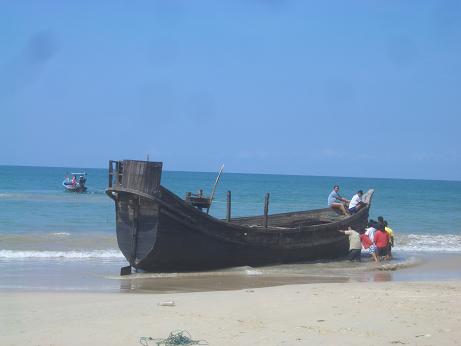
On December 5th, a small boat filled with 114 Burmese refugees landed on the shore of Khuk Khak in Thailand. The men (aged 10-54) had left Northern Burma (very tip, nearly Bangladesh) on November 16th. They left Burma to avoid forced labour for military construction, forced porter work, land confiscation, and forced evacuation of their homes. They had all contributed money to purchase the boat and travel together. They had anticipated that the trip would take approximately 10 days, but the motor on their boat broke part way through the journey, making their journey longer than anticipated and depleating their food supply. One of the men was injured on the journey, some had contracted disease, and many were weak. On the morning of the 5th, at about 4am, they met a Thai fisherman at sea who directed them to the coast. They arrived at 5am and walked up to the street, looking for work.

Thoo-chit, the Burmese director of Grassroots Human Rights and Education Development was out jogging by the market when he met them, all 114, sitting outside the market. He said that in fact he was quite scared -- they are muslim and currently in the south of Thailand there are brutal disputes with muslims. He said he thought they were Burmese, and suspected that they were just taken out of jail to go down to the south to fight. Others were scared too; Thai people were closing their shutters, and several called the police. Thoo-chit approached them and found that they were Burmese, and learned they had just arrived off their boat. They hadn't eaten in 10 days, so he distributed some food. Some Thai people did as well.


The police arrested them and took them to the prison in Takuapa (about 30km from here). Thoo-chit went as well to help to translate. They will be moved from this prison to the border where they will be investigated by the police. They will stay in the Thai prison for 2 weeks maximum. During this time, Grassroots will ensure they have food and religious needs taken care of. Then they will be deported back to Burma and handed over to the military regime. Thoo-chit stated that: "I strongly believe that if they are deported back to Burma they will undergo severe punishment and torchure."

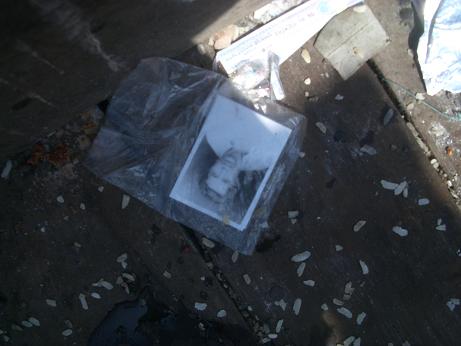
One man who lives closer to the water than we do was awaken by the men early in the morning, and so he knew where the boat was. He picked us up and took us to see it and to take some pictures to publish. The one above is about 100 plates scattered all across the beach.