[From Jovanni:] Today I received an extraordinary e-mail from Shahin Sayadi, the gifted Artistic Director of OneLight Theatre in Halifax. With Shahin's permission, The Red Hut reprints his essay in its entirety.
On Saturday, a day before the end of 2006, I called my sister in Tehran, Iran, to see if she had heard the news that our father’s murderer had been executed. She had not. In fact she wasn’t much interested. Only then I realized that I was not much interested, either. Why were we not interested in such news? And if we were not interested, why am I writing about it?
Arvand Rood, the Persian name for the river which, according to some others, is the Shat ol Arab, runs behind my paternal city of Khorramshahr, on the very tip of the Persian Gulf. It forms part of the border that separates Iran from Iraq. My Father, his parents and their parents were born in Khorramshahr. Myself, along with my mother and my siblings were born in Abadan, twenty minutes south of Khorramshahr, along the same river and border to Iraq. Every Friday, my mother would take my sister and I to Khorramshahr to visit our grandparents. They lived in an old house that, to a child, was somewhat scary and mysterious. Not a big house but big enough for a six year old to find a lot of hiding places. Beside my grandparents, my two great-grandmothers also lived in that house. The yard—where my grandma Zahra would barbeque lamb kabobs for us—had two very tall and very old trees in it; this yard was my main playground. Every time we were there I would try to climb these two trees and every time I would fall down and hurt myself and get in trouble. When I was ten, I finally succeeded in getting to the top of the date tree and from there, after eating a bunch of half-ripened kharak dates, of course, I remember looking around and seeing, on the horizon, the outskirts of a city. I asked my mother, who was standing below, praying loud and hard that I would not fall, where that city was and she said it was Basra, in Iraq.
Six years later, in the year 1980, Saddam Hussein Tekriti went on Iraqi national television and ripped to pieces a treaty that was signed between Iraq and Iran in 1950 to recognize that Arvand Rood was Iranian territory. He then declared war against Iran.
Saddam wanted to take my river. That river was full of sharks. My river, my sharks and my tree.
On 27 Shahrivar 1359 of the Iranian Calendar (September 18, 1980) Saddam’s jet fighters bombed my city of Abadan and the war had officially started. On that day only 21 people died in Abadan. The first day of the war. One of the dead was my father. The Iraqi ground troops had started moving towards Khorramshahr, crossing Arvand Rood and in less than a week they were walking over the ruble of my grandparents’ house and destroying my date tree. I forgot to tell you that at the foot of that date tree, there were two shrubs. One a green fig and the other a black fig. The black one was, and still is, my most favorite food. The fig trees were gone too. I remember the day that my grandparents, with only their birth certificates in their pockets, slippers on their feet and the clothes on their back came to our house. They did not know, yet, that their only child, my only father, had died.
Saddam, backed by many of the countries in the region, along with Europe, Russia and, of course, the US, went on killing hundreds of thousands of my people, causing displacement of over five million of my country’s men and women, and testing—yes testing—chemical weapons on Kurdish women and children.
But, we took back Khorramshahr and yes, Arvand Rood is still Arvand Rood.
A few years ago I took my wife to visit that house, well … I mean where once the house stood. And in a couple of weeks we’re going to visit the same rubble, but this time with my daughter. What do I tell the four year-old about the house? Does anyone know? How do I explain to her what happened to the date tree? Since she’s a big fan of the Shark Boy and Lava Girl, I’m certainly not going to tell her about what happened to the sharks.
Saddam was prosecuted for crimes against humanity and he was hanged quickly. Why? When are we going to hear from Saddam why he attacked my country, why he used chemical weapons on innocent Iranian children, and if he was just doing his job who was he taking his orders from? Yes, that is why Saddam was executed so quickly. My judgment was that Saddam should have had a much longer prosecution and perhaps a life sentence. Evil cannot be answered with evil. What I got for the New Year was nothing more than justice the American way. GWB is trying to fix my house because, apparently, he is more skilled in the upkeep of my river, in the health of my tree and in the way my sharks swim. So if that was justice, you can see why my sister and I are not so interested.
.........................
شاهین صیادی
Shahin Sayadi
Artistic Director
OneLight Theatre
902.425.6812
Monday, January 01, 2007


Wednesday, December 06, 2006
114 Burmese arrive in Khuk Khak
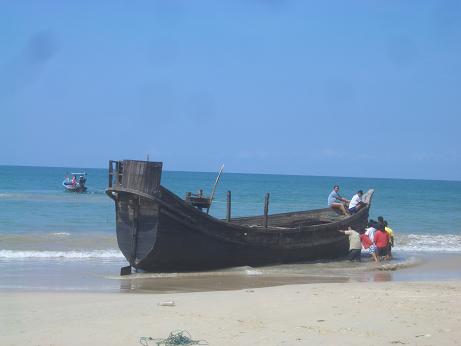
On December 5th, a small boat filled with 114 Burmese refugees landed on the shore of Khuk Khak in Thailand. The men (aged 10-54) had left Northern Burma (very tip, nearly Bangladesh) on November 16th. They left Burma to avoid forced labour for military construction, forced porter work, land confiscation, and forced evacuation of their homes. They had all contributed money to purchase the boat and travel together. They had anticipated that the trip would take approximately 10 days, but the motor on their boat broke part way through the journey, making their journey longer than anticipated and depleating their food supply. One of the men was injured on the journey, some had contracted disease, and many were weak. On the morning of the 5th, at about 4am, they met a Thai fisherman at sea who directed them to the coast. They arrived at 5am and walked up to the street, looking for work.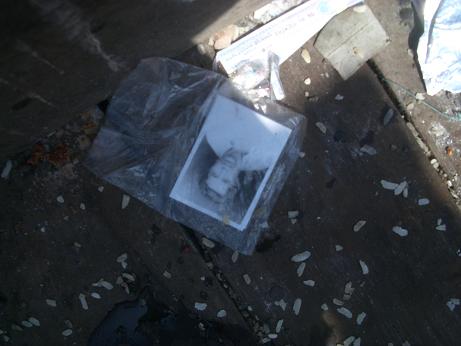
Thoo-chit, the Burmese director of Grassroots Human Rights and Education Development was out jogging by the market when he met them, all 114, sitting outside the market. He said that in fact he was quite scared -- they are muslim and currently in the south of Thailand there are brutal disputes with muslims. He said he thought they were Burmese, and suspected that they were just taken out of jail to go down to the south to fight. Others were scared too; Thai people were closing their shutters, and several called the police. Thoo-chit approached them and found that they were Burmese, and learned they had just arrived off their boat. They hadn't eaten in 10 days, so he distributed some food. Some Thai people did as well.
The police arrested them and took them to the prison in Takuapa (about 30km from here). Thoo-chit went as well to help to translate. They will be moved from this prison to the border where they will be investigated by the police. They will stay in the Thai prison for 2 weeks maximum. During this time, Grassroots will ensure they have food and religious needs taken care of. Then they will be deported back to Burma and handed over to the military regime. Thoo-chit stated that: "I strongly believe that if they are deported back to Burma they will undergo severe punishment and torchure."
 One man who lives closer to the water than we do was awaken by the men early in the morning, and so he knew where the boat was. He picked us up and took us to see it and to take some pictures to publish. The one above is about 100 plates scattered all across the beach.
Tuesday, November 28, 2006
No Soccer This Week
About a month ago, the Burmese in the area put together a soccer team. They approached us foreigners and urged us to put together a team as well. We did, and we've been playing every saturday. We lose by less and less each time!
The Burmese asked us, because the Thais wouldn't play them.
But this week, the Thai military government made a law that does not allow more than 5 foreigners to gather together in public. They said "foreigners", but they meant Burmese. And so no more soccer.
The Burmese asked us, because the Thais wouldn't play them.
But this week, the Thai military government made a law that does not allow more than 5 foreigners to gather together in public. They said "foreigners", but they meant Burmese. And so no more soccer.
Monday, November 27, 2006
My Chop-Sockey Love Affair
My love of kung fu movies began in the mid-70s. In the days before DVDs and VCRs, this meant going down to now-defunct Chinatown movie houses like the Pearl, the Shaw, and the Golden Harvest.
 As a seven year old, I marvelled at the seemingly superhuman abilities of performers such as Gordon Liu, Ti Lung, Philip Kwok, and, of course, Bruce Lee (already elevated to legendary status just a few years after his death). Thirty years later, I have clear memories of their amazing speed, agility, and precision. I also remember that back then, they were the only people on a movie screen who looked liked me.

The Five Vengeances is my theatrical homage to the heroes of my youth. It is a free adaptation of Thomas Middleton’s The Revenger’s Tragedy now retold in the style of a kung fu movie. The Five Vengeances retains the Jacobean flavour of the original play and adds high-flying kicks and chop-sockey sound effects performed live as our actors fight on-stage.
It should come as no surprise that Jacobean tragedy and kung fu fighting form a harmonious union. First, revenge is a central element in both forms of storytelling. In plays such as The Spanish Tragedy, The Changeling, and The Jew of Malta; and films such as The Five Deadly Venoms, The Crippled Avengers, and The Bride with White Hair, we see recurring themes of vengeance, betrayal, murder, and cruelty.
 Also, kung fu cinema lends itself well to stage adaptation because it actually derives from theatrical forms. Chinese opera typically presents great feats of athleticism, acrobatics, and martial arts. Many Hong Kong kung fu stars emerged from the ranks of Peking opera rather than through fighting schools. Legends such as Jackie Chan, Sammo Hung, and Corey Yuen were all disciples of Master Yu Jim Yuen at the Peking Opera School in Hong Kong. Though Bruce Lee studied Wing Chun at an academy, his father was a Cantonese Opera star.
 Here’s why I love the conceit of using kung fu conventions on stage: it allows one to present extraordinary people with extrordinary conflicts. In the beginning, all theatre was like this. We wrote about exclusively about gods and heroes and how they warred with other gods and heroes. Centuries later, we figured out that ordinary people could have extraordinary problems and that’s what we wrote about. Fast forward a few more hundred years, and the age of naturalism was born where we wrote about ordinary people with ordinary problems.
With The Five Vengeances, I’ve attempted to return to a mythological world where people can be propelled through the air, bare hands can stop swords, and virtue can defy insurmountable odds to conquer evil. Our heroes and villains all have extraordinary powers and their conflicts are literally life-and-death affairs.
If this adaptation is starting to sound somewhat earnest, rest assured that The Five Vengeances retains what good ol’ Wikipedia calls “the earthy—even obscene—style, irreverent tone, and grotesque subject matter that typifies Middleton’s comedies”.

If you enjoy kung fu movies, Jacobean Tragedy, Grand Guignol, or you basically like your drama over-the-top (like Knots Landing, for example), come and check out Cahoots’ workshop presentation of The Five Vengeances. The details of when and where are below.
It’s got kung fu, it’s got sex, it’s got Englebert Humperdinck. What more could you ask for?
***********************************************************
Humber Theatre in association with Cahoots Theatre Projects
presents a workshop presentation of
THE FIVE VENGEANCES by Jovanni Sy
directed by Guillermo Verdecchia & Jovanni Sy
composer/sound design by Richard Feren
fight choreography by Richard Lee & Kara Wooten
set design by Jackie Chau
lighting design by Bonnie Beecher
costume design by Sarah Armstrong
choreography by Anita Majumdar
Humber Studio Theatre
Lakeshore Campus, Colonel Samuel Smith Park Drive
(Kipling Avenue south of Lake Shore Boulevard West)
Performance dates and times:
Tue Nov 28 @ 8pm
Wed Nov 29 @ 8pm
Thu Nov 30 @ 8pm
Fri Dec 1 @ 8pm
Sat Dec 2 @ 2pm
Sat Dec 2 @ 8pm
Please call (416) 675-6622 x 3080 to reserve tickets
 As a seven year old, I marvelled at the seemingly superhuman abilities of performers such as Gordon Liu, Ti Lung, Philip Kwok, and, of course, Bruce Lee (already elevated to legendary status just a few years after his death). Thirty years later, I have clear memories of their amazing speed, agility, and precision. I also remember that back then, they were the only people on a movie screen who looked liked me.
The Five Vengeances is my theatrical homage to the heroes of my youth. It is a free adaptation of Thomas Middleton’s The Revenger’s Tragedy now retold in the style of a kung fu movie. The Five Vengeances retains the Jacobean flavour of the original play and adds high-flying kicks and chop-sockey sound effects performed live as our actors fight on-stage.
It should come as no surprise that Jacobean tragedy and kung fu fighting form a harmonious union. First, revenge is a central element in both forms of storytelling. In plays such as The Spanish Tragedy, The Changeling, and The Jew of Malta; and films such as The Five Deadly Venoms, The Crippled Avengers, and The Bride with White Hair, we see recurring themes of vengeance, betrayal, murder, and cruelty.
 Also, kung fu cinema lends itself well to stage adaptation because it actually derives from theatrical forms. Chinese opera typically presents great feats of athleticism, acrobatics, and martial arts. Many Hong Kong kung fu stars emerged from the ranks of Peking opera rather than through fighting schools. Legends such as Jackie Chan, Sammo Hung, and Corey Yuen were all disciples of Master Yu Jim Yuen at the Peking Opera School in Hong Kong. Though Bruce Lee studied Wing Chun at an academy, his father was a Cantonese Opera star.
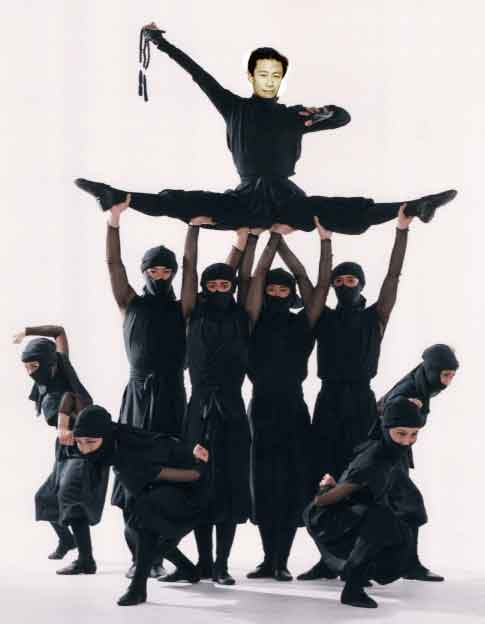 Here’s why I love the conceit of using kung fu conventions on stage: it allows one to present extraordinary people with extrordinary conflicts. In the beginning, all theatre was like this. We wrote about exclusively about gods and heroes and how they warred with other gods and heroes. Centuries later, we figured out that ordinary people could have extraordinary problems and that’s what we wrote about. Fast forward a few more hundred years, and the age of naturalism was born where we wrote about ordinary people with ordinary problems.
With The Five Vengeances, I’ve attempted to return to a mythological world where people can be propelled through the air, bare hands can stop swords, and virtue can defy insurmountable odds to conquer evil. Our heroes and villains all have extraordinary powers and their conflicts are literally life-and-death affairs.
If this adaptation is starting to sound somewhat earnest, rest assured that The Five Vengeances retains what good ol’ Wikipedia calls “the earthy—even obscene—style, irreverent tone, and grotesque subject matter that typifies Middleton’s comedies”.
If you enjoy kung fu movies, Jacobean Tragedy, Grand Guignol, or you basically like your drama over-the-top (like Knots Landing, for example), come and check out Cahoots’ workshop presentation of The Five Vengeances.
 The details of when and where are below.
It’s got kung fu, it’s got sex, it’s got Englebert Humperdinck. What more could you ask for?
***********************************************************
Humber Theatre in association with Cahoots Theatre Projects
presents a workshop presentation of
THE FIVE VENGEANCES by Jovanni Sy
directed by Guillermo Verdecchia & Jovanni Sy
composer/sound design by Richard Feren
fight choreography by Richard Lee & Kara Wooten
set design by Jackie Chau
lighting design by Bonnie Beecher
costume design by Sarah Armstrong
choreography by Anita Majumdar
Humber Studio Theatre
Lakeshore Campus, Colonel Samuel Smith Park Drive
(Kipling Avenue south of Lake Shore Boulevard West)
Performance dates and times:
Tue Nov 28 @ 8pm
Wed Nov 29 @ 8pm
Thu Nov 30 @ 8pm
Fri Dec 1 @ 8pm
Sat Dec 2 @ 2pm
Sat Dec 2 @ 8pm
Please call (416) 675-6622 x 3080 to reserve tickets
Wednesday, November 22, 2006
Conversations with Burmese Migrant Workers in Thailand
Earlier this week I visited my Burmese friend Atcha – she works at the human rights office for the Burmese (Grassroots) up the road. I’d interviewed her because I wanted to understand the situation in Burma. When I visited her this week I asked if there were other people who I might be able to talk with. She told me I could come along on Wednesday (today), because she was going to survey migrant workers about why they left Burma, as part of a report for the UN.
I slept in, unfortunately, because I have a terrible cough that keeps me up at night, but goes away after the sun rises, allowing me to sleep well into the morning. Pal, a friend from Australia who speaks exactly the same language as me when it comes to doing this sort of work (and is completing a fascinating degree in social inquiry) called me and woke me up, asking where I was. I got on my bike and rushed to the centre. We forgot that we were working in Thai time though… and our 10am pick up happened at about 130.
It was a long road trip, and Pal and I weren’t even sure where we were going or what we’d accomplish during the day… could we even ask questions to the workers or did they not speak English? Would Atcha and Pupu be willing to translate for us – to support our research – or would we listen in on their work? We didn’t really care what would happen. On the drive down, we asked a lot of questions about Burma…
Then we got on this road… and I thought, holy smokes, I have never been on a road like this in a place like this. We were going into the rubber plantation. The road was bumpy as hell and lasted 10 minutes, weaving and winding, and very possible to go over the edge. I trusted our driver – even though I never introduced myself to him the whole day, never made eye contact, never said hi… he kept to his role. He took off his shades at one point in the day and I sort of saw his eyes and face in the rear view mirror.
So our first stop was the little protected community in the middle of the rubber plantation. There was a learning centre there (a tiny outdoorish building) on the top of a hill. Kids inside. Two teachers, each teaching from opposite sides of the class on white boards that didn’t really erase. They were cool teachers though, making the kids laugh and stuff. But didn’t mind stopping class to do the surveys with Pupu. Atcha and Pal and I went into one of the homes and sat on the floor with a mother. Atcha said we could interview her and she would translate for us. It was fun – people came in and out, giving us pepsi, hanging out listening in on the window sill, in the doorway.
We didn’t ask her name… She is from Mandali and has been in Thailand for 4 years. Back in Burma she worked for a small company, but the salary was too small to support her family. Her and her husband contacted someone about coming to Thailand. Here, she saves her money and sends it to Burma. She wants to go back to Burma, and hopefully will in about one year – when she saves enough money. Here, she works as a teacher, and her husband works on the rubber plantation.
Her journey to Thailand should have taken 1 week, but they were halted in ktown (lookup?) for a month. Their broker took their 6000B and took off, without completing his side of the deal, so they needed to work odd jobs in this border city before they could pay another broker to take them. They crossed in a boat to Ranong with 10 other people. It was about 6 months after they arrived in Thailand that they were able to contact their family to let them know that they arrived safely and were working in Thailand.
We tried to ask her about the political situation in Burma, but she didn’t really understand. She talked about forced labour that was happening to men in her village for road and dam construction, but it was hard to grasp if this was happening to people she knew… She came for higher wages – economic reasons. She says that now she is in Thailand, she can see that there are problems with the way of life in Burma. She says that here, even the poor people have tvs. She can see the standard of living is really nice here, and she said that now she can see that Burma needs international help, and needs a democracy.
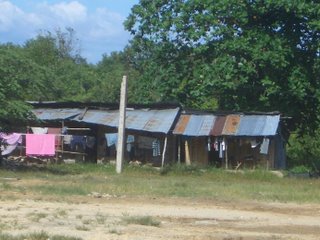
I looked around her place at that point. It’s a tin can with a concrete floor – but it did have a tv, huge speakers, loads of cds, a vcd player, a jug of clean drinking water, a religious shrine, nicely decorated. Paper posters up on the wall – of weird things! Pop stars, I think. Haha!
Her and her husband are illegal – as are most of the migrant workers – and so they stay in this little community in the rubber plantation. They have safety here – their thai employer has a responsibility for them. I asked if they have any community with the Thai people and it seems that she feels a safety with the thai manager – but the Burmese and thai don’t work the same job. No thai person works the same jobs as the Burmese on the rubber plantation – the thais are the managers. She said the work is very hard. They work 7-11, lunch 11-12, then again 12-3, and it’s difficult work. Her work in Burma was easier, she said, in an office, but the wages were not nearly as good. Here, men make 140B/day, and women 130B/day (and don’t get me started on lower for wages for women is apparently ok ). In Burma, she was paid 2000Jaz/day but would spend it all. Here, she can save half of her wages. I gather they are quite lucky with their manager. The girls have been telling me that there exist serious problems for the migrant workers in Thailand because they are not always given their wages… and if they stop showing up to work because they aren’t getting paid, their managers call the police – and then they are deported back to Burma. Common procedure.
She has a cute daughter who had mixed emotions about the pepsi we were putting in her mouth. Her mother said she wanted her daughter to go back to Burma, and go to school.
We said thank you in Burmese when we left, and everyone got a big kick out of that! Haha! Gi su timaray!
I started to feel like the work at Grassroots is totally valuable because it’s about human rights. And so often here at the tsunami volunteer centre we all question our position as westerners here helping… are we imposing western solutions… all sorts of questions… but I think when it comes to human rights, there is no such thing as a cultural division to look out for.
Back in the truck we started we all got a little goofy ‘cause we were all trying to speak Thai. Realized I’ve got a lot in common with the Burmese… we neither of us can speak Thai! It does rather show the power of the Burmese communities here that they live here and never need to learn it. The girls said that only a few, if they stay here for years and years learn some Thai. But usually they live in these hideout spots like the rubber plantation communities, and really don’t have the need.
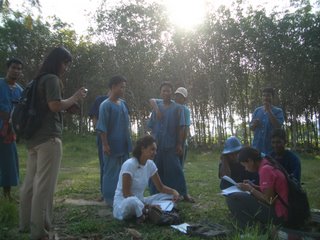
Next stop was Safari Island! A tourist elephant riding place, and a hotpot for Burmese workers, training the elephants. We goofed off at first, had ice cream, watched the monkey-on-leash do tricks (Atcha grabs me and jokes “animal rights ne?”). The Burmese were all dressed in blue uniforms for their work and they all followed us as a group out to the back of the park and we sat on the ground to do the surveys that the girls had prepared. We were just interviewing one guy, but everybody else gathered around. The man, from Mandali, left in 2003 because of lack of work and a concern for his family. He came to earn more money to support his family. Back home he worked on a bus as a ticket-taker. The government forced him to leave his home because his family had a skin disease, so they were forced to leave the city and move out to the country side.
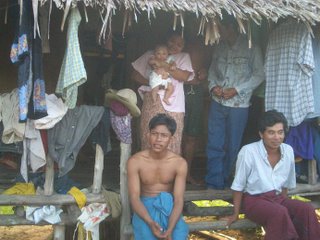
I think that the workers wanted to get home, so they told us to come with them and do the interviews at their home rather than in the back of the park. I think that’s what happened ‘cause we got back in the truck and drove the long way around (they were on motor bikes so just drove on the wrong side of the road). There were about 3 homes in the middle of a field – and then another 3 homes a bit further over. And a few elephants behind the homes (chained??). The houses were built from wood and plants. We sat on the porch and everyone sort of listened in. Different than surveys back home. No closed doors… no asking for confidentiality. No informed consent sheet. Sometimes one person would do the first half of the survey and someone else would finish it. One of the girls would sometimes hit the person they were surveying to get them to pay attention again if they got giggling with the others.
The girls asked the questions of the survey and wrote the answers, translating for us as they went along. We threw in the occasional question too, and people were happy to answer. One man said he’s been here for 7 months. Came to avoid forced labour and heavy taxation. He couldn’t feed himself and his family. Back home he was a farmer. On his way through Burma to the border, he had a lot of trouble, was stopped many times at many check points and had to pay a lot of money. 12 others from his village were doing the same thing along side him.
As a farmer, he was forced to grow cotton. Then he was forced to sell the cotton to the government at a cheaper price. Then he was evicted from his home so the government could begin a development project on that land – a dam. That’s when he decided to leave Burma. Others left with him because of money, lack of work, to avoid forced labour and other human rights abuses. He said that the army would try to force them to be soldiers. If they refused, they would be beaten and tortured. He knows people from his village in this situation.
Another man, from Pyee Bew township, Mandalai Division, came in June 2006 after 6 days of traveling. He talked about problems with his ID card. It seems that in Burma, you have a birth certificate and a student card until you are 18. They you apply for a citizenship card. But this costs a lot of money (although the price seems to be dependant on your situation). Without a citizenship card, you can’t travel outside the province. People are arrested if they don’t have this card.
As much as I was saying before that you didn’t need to shut a door to talk about these things with the people, you could tell it wasn’t a breeze. The best I can describe the way people were talking was that they weren’t really breathing when they were talking.
I asked if they were happy to be in Thailand. They said no, not happy. But the income was their reason for being here. They are saving up to go back to Burma. Then I asked (finally) what I was dying to ask: …but aren’t you scared to go back? Are you nervous about the forced labour. They said yes, yes they are scared. But their family is there.
Their journey across the border involved them laying on the boat, covered in a sheet. They said they couldn’t breath. 5000B/person to the broker.
I’ve got the names of the towns near where they crossed, but I’ll have to look them up. Small places though, Pupu said.
I asked if they felt like their country needed international help. (I asked this a bit for myself – do you want my help? My country’s help? Tell me if you think there is trouble that needs fixing here. I see trouble… but do you? Do you just want to me stay away?) I noticed when Pupu translated she said ‘tsunami’, comparing I think the amount of international help that the tsunami received. They all nodded their heads. Yes. International help. Help. They mentioned education for the kids. And health care – they say there are a lot of diseases in Burma: HIV, TB, Malaria.
The reception that I felt as a foreigner was much different from the Burmese than I usually feel from the Thai – perhaps because we’re both outsiders – albeit in very different ways. Noticeably a different relationship though.
Ming Glaba (good day), for now.
I slept in, unfortunately, because I have a terrible cough that keeps me up at night, but goes away after the sun rises, allowing me to sleep well into the morning. Pal, a friend from Australia who speaks exactly the same language as me when it comes to doing this sort of work (and is completing a fascinating degree in social inquiry) called me and woke me up, asking where I was. I got on my bike and rushed to the centre. We forgot that we were working in Thai time though… and our 10am pick up happened at about 130.
It was a long road trip, and Pal and I weren’t even sure where we were going or what we’d accomplish during the day… could we even ask questions to the workers or did they not speak English? Would Atcha and Pupu be willing to translate for us – to support our research – or would we listen in on their work? We didn’t really care what would happen. On the drive down, we asked a lot of questions about Burma…
Then we got on this road… and I thought, holy smokes, I have never been on a road like this in a place like this. We were going into the rubber plantation. The road was bumpy as hell and lasted 10 minutes, weaving and winding, and very possible to go over the edge. I trusted our driver – even though I never introduced myself to him the whole day, never made eye contact, never said hi… he kept to his role. He took off his shades at one point in the day and I sort of saw his eyes and face in the rear view mirror.
So our first stop was the little protected community in the middle of the rubber plantation. There was a learning centre there (a tiny outdoorish building) on the top of a hill. Kids inside. Two teachers, each teaching from opposite sides of the class on white boards that didn’t really erase. They were cool teachers though, making the kids laugh and stuff. But didn’t mind stopping class to do the surveys with Pupu. Atcha and Pal and I went into one of the homes and sat on the floor with a mother. Atcha said we could interview her and she would translate for us. It was fun – people came in and out, giving us pepsi, hanging out listening in on the window sill, in the doorway.
We didn’t ask her name… She is from Mandali and has been in Thailand for 4 years. Back in Burma she worked for a small company, but the salary was too small to support her family. Her and her husband contacted someone about coming to Thailand. Here, she saves her money and sends it to Burma. She wants to go back to Burma, and hopefully will in about one year – when she saves enough money. Here, she works as a teacher, and her husband works on the rubber plantation.
Her journey to Thailand should have taken 1 week, but they were halted in ktown (lookup?) for a month. Their broker took their 6000B and took off, without completing his side of the deal, so they needed to work odd jobs in this border city before they could pay another broker to take them. They crossed in a boat to Ranong with 10 other people. It was about 6 months after they arrived in Thailand that they were able to contact their family to let them know that they arrived safely and were working in Thailand.
We tried to ask her about the political situation in Burma, but she didn’t really understand. She talked about forced labour that was happening to men in her village for road and dam construction, but it was hard to grasp if this was happening to people she knew… She came for higher wages – economic reasons. She says that now she is in Thailand, she can see that there are problems with the way of life in Burma. She says that here, even the poor people have tvs. She can see the standard of living is really nice here, and she said that now she can see that Burma needs international help, and needs a democracy.
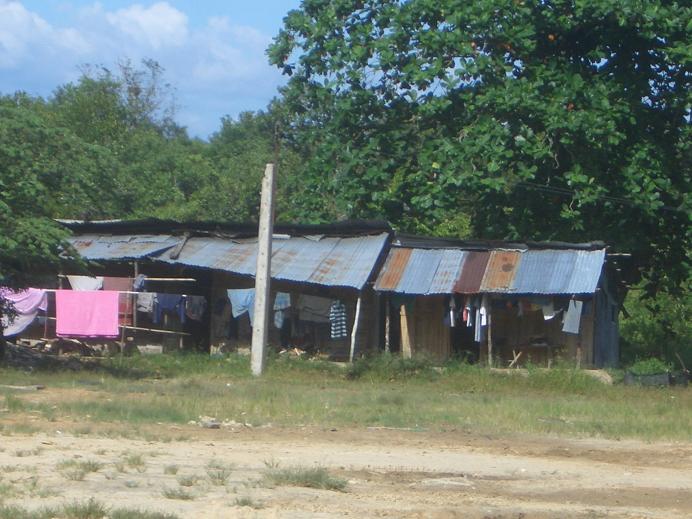
I looked around her place at that point. It’s a tin can with a concrete floor – but it did have a tv, huge speakers, loads of cds, a vcd player, a jug of clean drinking water, a religious shrine, nicely decorated. Paper posters up on the wall – of weird things! Pop stars, I think. Haha!
Her and her husband are illegal – as are most of the migrant workers – and so they stay in this little community in the rubber plantation. They have safety here – their thai employer has a responsibility for them. I asked if they have any community with the Thai people and it seems that she feels a safety with the thai manager – but the Burmese and thai don’t work the same job. No thai person works the same jobs as the Burmese on the rubber plantation – the thais are the managers. She said the work is very hard. They work 7-11, lunch 11-12, then again 12-3, and it’s difficult work. Her work in Burma was easier, she said, in an office, but the wages were not nearly as good. Here, men make 140B/day, and women 130B/day (and don’t get me started on lower for wages for women is apparently ok ). In Burma, she was paid 2000Jaz/day but would spend it all. Here, she can save half of her wages. I gather they are quite lucky with their manager. The girls have been telling me that there exist serious problems for the migrant workers in Thailand because they are not always given their wages… and if they stop showing up to work because they aren’t getting paid, their managers call the police – and then they are deported back to Burma. Common procedure.
She has a cute daughter who had mixed emotions about the pepsi we were putting in her mouth. Her mother said she wanted her daughter to go back to Burma, and go to school.
We said thank you in Burmese when we left, and everyone got a big kick out of that! Haha! Gi su timaray!
I started to feel like the work at Grassroots is totally valuable because it’s about human rights. And so often here at the tsunami volunteer centre we all question our position as westerners here helping… are we imposing western solutions… all sorts of questions… but I think when it comes to human rights, there is no such thing as a cultural division to look out for.
Back in the truck we started we all got a little goofy ‘cause we were all trying to speak Thai. Realized I’ve got a lot in common with the Burmese… we neither of us can speak Thai! It does rather show the power of the Burmese communities here that they live here and never need to learn it. The girls said that only a few, if they stay here for years and years learn some Thai. But usually they live in these hideout spots like the rubber plantation communities, and really don’t have the need.
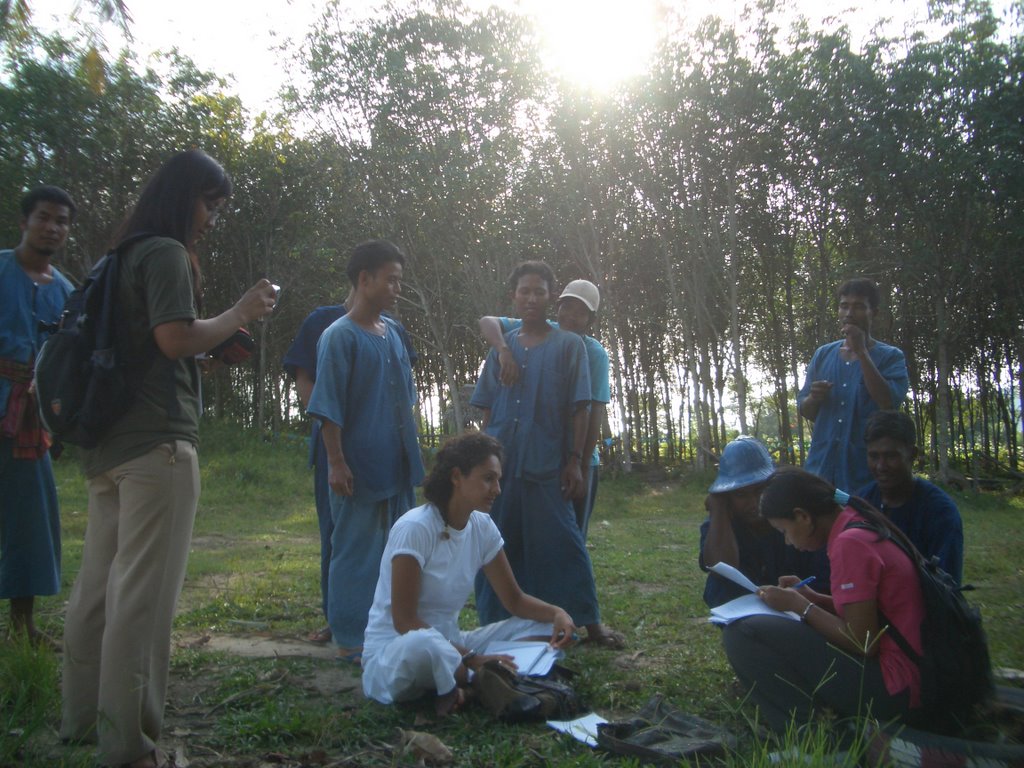
Next stop was Safari Island! A tourist elephant riding place, and a hotpot for Burmese workers, training the elephants. We goofed off at first, had ice cream, watched the monkey-on-leash do tricks (Atcha grabs me and jokes “animal rights ne?”). The Burmese were all dressed in blue uniforms for their work and they all followed us as a group out to the back of the park and we sat on the ground to do the surveys that the girls had prepared. We were just interviewing one guy, but everybody else gathered around. The man, from Mandali, left in 2003 because of lack of work and a concern for his family. He came to earn more money to support his family. Back home he worked on a bus as a ticket-taker. The government forced him to leave his home because his family had a skin disease, so they were forced to leave the city and move out to the country side.
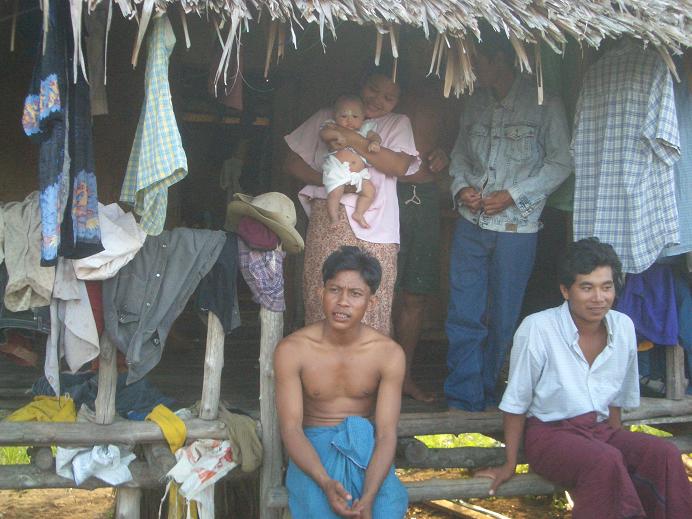
I think that the workers wanted to get home, so they told us to come with them and do the interviews at their home rather than in the back of the park. I think that’s what happened ‘cause we got back in the truck and drove the long way around (they were on motor bikes so just drove on the wrong side of the road). There were about 3 homes in the middle of a field – and then another 3 homes a bit further over. And a few elephants behind the homes (chained??). The houses were built from wood and plants. We sat on the porch and everyone sort of listened in. Different than surveys back home. No closed doors… no asking for confidentiality. No informed consent sheet. Sometimes one person would do the first half of the survey and someone else would finish it. One of the girls would sometimes hit the person they were surveying to get them to pay attention again if they got giggling with the others.
The girls asked the questions of the survey and wrote the answers, translating for us as they went along. We threw in the occasional question too, and people were happy to answer. One man said he’s been here for 7 months. Came to avoid forced labour and heavy taxation. He couldn’t feed himself and his family. Back home he was a farmer. On his way through Burma to the border, he had a lot of trouble, was stopped many times at many check points and had to pay a lot of money. 12 others from his village were doing the same thing along side him.
As a farmer, he was forced to grow cotton. Then he was forced to sell the cotton to the government at a cheaper price. Then he was evicted from his home so the government could begin a development project on that land – a dam. That’s when he decided to leave Burma. Others left with him because of money, lack of work, to avoid forced labour and other human rights abuses. He said that the army would try to force them to be soldiers. If they refused, they would be beaten and tortured. He knows people from his village in this situation.
Another man, from Pyee Bew township, Mandalai Division, came in June 2006 after 6 days of traveling. He talked about problems with his ID card. It seems that in Burma, you have a birth certificate and a student card until you are 18. They you apply for a citizenship card. But this costs a lot of money (although the price seems to be dependant on your situation). Without a citizenship card, you can’t travel outside the province. People are arrested if they don’t have this card.
As much as I was saying before that you didn’t need to shut a door to talk about these things with the people, you could tell it wasn’t a breeze. The best I can describe the way people were talking was that they weren’t really breathing when they were talking.
I asked if they were happy to be in Thailand. They said no, not happy. But the income was their reason for being here. They are saving up to go back to Burma. Then I asked (finally) what I was dying to ask: …but aren’t you scared to go back? Are you nervous about the forced labour. They said yes, yes they are scared. But their family is there.
Their journey across the border involved them laying on the boat, covered in a sheet. They said they couldn’t breath. 5000B/person to the broker.
I’ve got the names of the towns near where they crossed, but I’ll have to look them up. Small places though, Pupu said.
I asked if they felt like their country needed international help. (I asked this a bit for myself – do you want my help? My country’s help? Tell me if you think there is trouble that needs fixing here. I see trouble… but do you? Do you just want to me stay away?) I noticed when Pupu translated she said ‘tsunami’, comparing I think the amount of international help that the tsunami received. They all nodded their heads. Yes. International help. Help. They mentioned education for the kids. And health care – they say there are a lot of diseases in Burma: HIV, TB, Malaria.
The reception that I felt as a foreigner was much different from the Burmese than I usually feel from the Thai – perhaps because we’re both outsiders – albeit in very different ways. Noticeably a different relationship though.
Ming Glaba (good day), for now.
Tuesday, November 21, 2006
Visa Run
A visa run to Burma is popular for Thai tourists. A few hours on the bus, a quick boat ride, a crisp American 10 dollar bill, and you're over and back the border like it was as easy as crossing the street. Easy, if you can ignore that you have this priviledge of jumping back and forth, while you watch the security screens showing people handcuffed laying on the floor, and truckloads of illegal burmese refugees caught at the border.
Of the 10 dollars you give to cross into Burma, only to return into Thailand, 4 goes directly to the military.
Not that I'm necessarily recommending a stay in Burma. It's hard to stay in Burma without supporting the military government. The hotels are government owned, the tourists attractions, the transport. And it's a terrible thing to support. These toursits attractions were built by forced slave labour... people picked out of their homes and forced to work for no pay, building nice roads and tourist attractions so other people can live comfortably in their country. There are many websites that talk of boycotting travelling to Burma altogether. I have a Burmese friend here who suggested that travelling to Burma is important - to talk with the people, and help to spread an education to the world about what is happening in their country. But responsible travel to Burma would be essential. I refuse to give a single dollar to the military.
James, a Burmese friend who works in a shop along the main road here, and who I sit out with chatting most evenings, often talks with me about his country. He always has his burmese/english dictionary with him (his english is really strong - much stronger than my burmese!) and the first thing he learned how to say in english that he wrote in the front cover of the book is:
"I really hate the military control in my country."
Of the 10 dollars you give to cross into Burma, only to return into Thailand, 4 goes directly to the military.
Not that I'm necessarily recommending a stay in Burma. It's hard to stay in Burma without supporting the military government. The hotels are government owned, the tourists attractions, the transport. And it's a terrible thing to support. These toursits attractions were built by forced slave labour... people picked out of their homes and forced to work for no pay, building nice roads and tourist attractions so other people can live comfortably in their country. There are many websites that talk of boycotting travelling to Burma altogether. I have a Burmese friend here who suggested that travelling to Burma is important - to talk with the people, and help to spread an education to the world about what is happening in their country. But responsible travel to Burma would be essential. I refuse to give a single dollar to the military.
James, a Burmese friend who works in a shop along the main road here, and who I sit out with chatting most evenings, often talks with me about his country. He always has his burmese/english dictionary with him (his english is really strong - much stronger than my burmese!) and the first thing he learned how to say in english that he wrote in the front cover of the book is:
"I really hate the military control in my country."
Press Release
Thai fisherman, a Crown Prince, and 50 Countries build a better future for villagers.
What takes a Crown Prince, 52 nationalities, a swamp, tools galore, a ton of hot dirty builders and the brains of fishermen?
The answer is of course the Ban Man Chaow village and it is now complete! Thanks to the widest array of people, classes and cultures ever assembled in Thailand. These fishermen had been forgotten after the Asian Tsunami of 2004 when the Governmental and Non Governmental Organizations (NGO) support went directly to previous homeowners, leaving the worst off worser off.
This group did not wait for handouts! They took control and banded together, created a co-op and attracted the attention of the Crown Prince of Denmark, NGOs the world over, and new skills the local people didn’t know they had!
The Rent Homes Group, established in response to the neglect of this group after the Tsunami by the villagers (fishermen) themselves. The results have been tremendous and with 50 homes built each for less than $3000 US each, no mean achievement! This project was built on the sweat of over 50 nations, not least the Thai’s who led every stage themselves.
This spirit of international co-operation with a Thai leadership has proved so successful that there is a project now as a result a new village in the making, called Ban Naem Cem 2. Here the first stone has just been laid to build a town which is again sustainable and just what the people want.
This project is about empowerment, the people here have come from nothing to earn something they can call their own. There are opportunities for people of all nationalities to volunteer and use there skills on the new town to build a better future for the poorest people who were affected by this tragic event.
If you would like to volunteer over the next year and want to have the experience of a lifetime, please contact the Tsunami Volunteer Centre in Khao Lak Thailand on our website. www.tsunamivolunteer.com or via email Sheila@tsunami.com
--
by ulla laidlaw and jack bradley
--
And a little commentary.......
Nam Khem is finished!!....anyone..? anyone..?
We wrote up this press release, because we thought that this mattered. It mattered that there were people still living in temporary housing after 2 years. Did everybody know this?? Was everybody ok with this?? I didn't know it... and I'm not really ok with it either. But it surprises me that "the world" doesn't know that help is still needed, and it surprises me that "the world" doesn't hear about the accomplishments either. About 2 weeks after I arrived, I went to a ceremoney at the boatyard - 50 fishermen received the papers for their boats. That's a big deal! It takes a lot to build 50 boats. And last week, we finished a village - that's a big deal too! My north american brain turned on and wondered about the media... there wasn't a radio station, a journalist, a video cam to be seen (only a whole lot of digital cams that the kids kept stealing and running around with). It would have been a wonderful thing to film, to show "the world." I had spent several weeks laying floors, building walls etc. on this site and part of me spent the whole time thinking it was a little bit dreer.... just houses, that's it, build on a swamp, with a dusty road between them. But the evening that we celebrated it's completion, the community felt so alive! Kids dressed up dancing traditional dance, parents cooking for the foreigners, and everyone dancing. ....but I do wonder why nobody notices... and it scares me a bit because Nam Khem 2 is starting this week, and the initial work is hard. Laying foundations for the homes, in the hot sun, on a piece of land with no shade. I've had a few times where despite the fact that we're all keeping eachothers' spirits up, there are moment when I feel like I need help. It's hot, it's late in the day, I'm tired and why are there only 6 of us here today? Can't someone else help to mix this cement... It's far from every moment I feel that, but it does happen, and in those moments I get a little scared at the enormity of the project ahead. We've got to build another 50 houses, from scratch... and I'd like a few more people to come and help out. So at times like that, I wish there was a bit of media who would still follow a story 2 years later.
And that gets me started a bit on other things.... because Thailand's doing pretty good! This town has really woken up in the last few weeks... the tourists are really coming back and businesses are happy. I'm complaining about 50 families in temporary houses (and I don't want to belittle that), but Indonesia was far worse hit than Thailand and hasn't seen nearly the same sort of response. (Which almost shames all volunteers here...why are we here and not where we are really needed). And then there's Burma. Which apparently wasn't hit. Which reported 60 deaths.... did the wave just stop on the Burmese coast? But no one can even go to help there. Hush, hush, hush about Burma.
What takes a Crown Prince, 52 nationalities, a swamp, tools galore, a ton of hot dirty builders and the brains of fishermen?
The answer is of course the Ban Man Chaow village and it is now complete! Thanks to the widest array of people, classes and cultures ever assembled in Thailand. These fishermen had been forgotten after the Asian Tsunami of 2004 when the Governmental and Non Governmental Organizations (NGO) support went directly to previous homeowners, leaving the worst off worser off.
This group did not wait for handouts! They took control and banded together, created a co-op and attracted the attention of the Crown Prince of Denmark, NGOs the world over, and new skills the local people didn’t know they had!
The Rent Homes Group, established in response to the neglect of this group after the Tsunami by the villagers (fishermen) themselves. The results have been tremendous and with 50 homes built each for less than $3000 US each, no mean achievement! This project was built on the sweat of over 50 nations, not least the Thai’s who led every stage themselves.
This spirit of international co-operation with a Thai leadership has proved so successful that there is a project now as a result a new village in the making, called Ban Naem Cem 2. Here the first stone has just been laid to build a town which is again sustainable and just what the people want.
This project is about empowerment, the people here have come from nothing to earn something they can call their own. There are opportunities for people of all nationalities to volunteer and use there skills on the new town to build a better future for the poorest people who were affected by this tragic event.
If you would like to volunteer over the next year and want to have the experience of a lifetime, please contact the Tsunami Volunteer Centre in Khao Lak Thailand on our website. www.tsunamivolunteer.com or via email Sheila@tsunami.com
--
by ulla laidlaw and jack bradley
--
And a little commentary.......
Nam Khem is finished!!....anyone..? anyone..?
We wrote up this press release, because we thought that this mattered. It mattered that there were people still living in temporary housing after 2 years. Did everybody know this?? Was everybody ok with this?? I didn't know it... and I'm not really ok with it either. But it surprises me that "the world" doesn't know that help is still needed, and it surprises me that "the world" doesn't hear about the accomplishments either. About 2 weeks after I arrived, I went to a ceremoney at the boatyard - 50 fishermen received the papers for their boats. That's a big deal! It takes a lot to build 50 boats. And last week, we finished a village - that's a big deal too! My north american brain turned on and wondered about the media... there wasn't a radio station, a journalist, a video cam to be seen (only a whole lot of digital cams that the kids kept stealing and running around with). It would have been a wonderful thing to film, to show "the world." I had spent several weeks laying floors, building walls etc. on this site and part of me spent the whole time thinking it was a little bit dreer.... just houses, that's it, build on a swamp, with a dusty road between them. But the evening that we celebrated it's completion, the community felt so alive! Kids dressed up dancing traditional dance, parents cooking for the foreigners, and everyone dancing. ....but I do wonder why nobody notices... and it scares me a bit because Nam Khem 2 is starting this week, and the initial work is hard. Laying foundations for the homes, in the hot sun, on a piece of land with no shade. I've had a few times where despite the fact that we're all keeping eachothers' spirits up, there are moment when I feel like I need help. It's hot, it's late in the day, I'm tired and why are there only 6 of us here today? Can't someone else help to mix this cement... It's far from every moment I feel that, but it does happen, and in those moments I get a little scared at the enormity of the project ahead. We've got to build another 50 houses, from scratch... and I'd like a few more people to come and help out. So at times like that, I wish there was a bit of media who would still follow a story 2 years later.
And that gets me started a bit on other things.... because Thailand's doing pretty good! This town has really woken up in the last few weeks... the tourists are really coming back and businesses are happy. I'm complaining about 50 families in temporary houses (and I don't want to belittle that), but Indonesia was far worse hit than Thailand and hasn't seen nearly the same sort of response. (Which almost shames all volunteers here...why are we here and not where we are really needed). And then there's Burma. Which apparently wasn't hit. Which reported 60 deaths.... did the wave just stop on the Burmese coast? But no one can even go to help there. Hush, hush, hush about Burma.
Monday, November 20, 2006
Catch Upcoming Toronto date with Suba Sankaran and Autorickshaw
The Red Hut
hey all,
Take note, it's a busy fall season for Dora award winning sound designer on Bombay Black, Ms. Suba Sankaran. She's performing all over the place with Autorickshaw - including an upcoming tour of India. You can catch the band live in Toronto; that's this month...on November 18. You can get full details on tour plans etc at http://www.autorickshaw.ca.
here are the short specs:
Concert:
Saturday November 18, 2006 at 7:30 pm
The ARC Theatre (Academic Resource Centre)
University of Toronto at Scarborough
Tickets (Reserved):
$12 Adults
$10 Students and Seniors
Box office:
http://www.utsc.utoronto.ca/%7Ecultural/music.html
Autorickshaw will be premiering a new composition, ‘Simhanandana’, by master drummer Trichy Sankaran, (commission supported by the Ontario Arts Council).
A New CD is in the final stages of production and is entitled, ‘So The Journey Goes’, with a release planned for the new year.
So The Journey Goes features autorickshaw with some very special guests:
Kevin Breit-guitar
Mark McLean-drums
Trichy Sankaran-mrdangam
John Gzowski-guitar
George Koller-dilruba
Dylan Bell - wurlitzer
And a seven-piece horn section from the Hannaford Street Silver Band
hey all,
Take note, it's a busy fall season for Dora award winning sound designer on Bombay Black, Ms. Suba Sankaran. She's performing all over the place with Autorickshaw - including an upcoming tour of India. You can catch the band live in Toronto; that's this month...on November 18. You can get full details on tour plans etc at http://www.autorickshaw.ca.
here are the short specs:
Concert:
Saturday November 18, 2006 at 7:30 pm
The ARC Theatre (Academic Resource Centre)
University of Toronto at Scarborough
Tickets (Reserved):
$12 Adults
$10 Students and Seniors
Box office:
http://www.utsc.utoronto.ca/%7Ecultural/music.html
Autorickshaw will be premiering a new composition, ‘Simhanandana’, by master drummer Trichy Sankaran, (commission supported by the Ontario Arts Council).
A New CD is in the final stages of production and is entitled, ‘So The Journey Goes’, with a release planned for the new year.
So The Journey Goes features autorickshaw with some very special guests:
Kevin Breit-guitar
Mark McLean-drums
Trichy Sankaran-mrdangam
John Gzowski-guitar
George Koller-dilruba
Dylan Bell - wurlitzer
And a seven-piece horn section from the Hannaford Street Silver Band
Friday, November 03, 2006
Call for Submissions for all you Interdisciplinarians!
The Red Hut
Anyone interested in collaborative, interdisciplinary projects should really take a look at this commissioning project through FRESH GROUND NEW WORKS (Harbourfront Centre)...
Here are the deets:
The deadline for the Call for Submissions for Fresh Ground 2007-2008 (Stage One) is Friday, December 1.
You are encouraged to take a look at the criteria and please contact me or the contact given with any questions.
http://www.harbourfrontcentre.com/noflash/submissions/submissions.php
Anyone interested in collaborative, interdisciplinary projects should really take a look at this commissioning project through FRESH GROUND NEW WORKS (Harbourfront Centre)...
Here are the deets:
The deadline for the Call for Submissions for Fresh Ground 2007-2008 (Stage One) is Friday, December 1.
You are encouraged to take a look at the criteria and please contact me or the contact given with any questions.
http://www.harbourfrontcentre.com/noflash/submissions/submissions.php
Modern Times Brings you Visual Art!
The Red Hut
Modern Times continues to stretch its boundaries and now takes us into the visual arts. Read on re. Modern Times bringing us the compelling contemporary work of Iranian visual artist Aydin Aghdashloo:
From November 2nd to 16th, 2006, Arta Gallery in association with Modern Times Stage Company will be presenting the works of celebrated Iranian artist, Aydin Aghdashloo, in his North American premiere. Aydin is regarded as one of the most important and influential Iranian artists. He is an authentic visionary who has created unique and wondrously compelling paintings. Aydin’s work is also regarded as the illustrated history of Iran, both ancient and contemporary.
For more information about the event and Aydin Aghdashloo, please check the Modern Times Stage Company website:http://www.moderntimesstage.com/upcoming.html
Modern Times continues to stretch its boundaries and now takes us into the visual arts. Read on re. Modern Times bringing us the compelling contemporary work of Iranian visual artist Aydin Aghdashloo:
From November 2nd to 16th, 2006, Arta Gallery in association with Modern Times Stage Company will be presenting the works of celebrated Iranian artist, Aydin Aghdashloo, in his North American premiere. Aydin is regarded as one of the most important and influential Iranian artists. He is an authentic visionary who has created unique and wondrously compelling paintings. Aydin’s work is also regarded as the illustrated history of Iran, both ancient and contemporary.
For more information about the event and Aydin Aghdashloo, please check the Modern Times Stage Company website:http://www.moderntimesstage.com/upcoming.html
Tuesday, October 31, 2006
more time, you writer types
THEATRE CREATORS' RESERVE
DEADLINE EXTENDED to November 15, 2006!!
DEADLINE EXTENDED to November 15, 2006!!
Cahoots Theatre Projects is a theatre recommender for the Theatre Creators’ Reserve. This program allows artists time and support to work on new creations by applying to theatre companies who in turn recommend funding from the Ontario Arts Council.
Please consult the OAC's information page for more details.
Artists interested in applying for this year's program are asked to review the Cahoots’ mandate. In keeping with our mandate, preference will be given to artists that reflect Cahoots’ core beliefs and values. Cahoots strongly encourages submissions from artists working in non-text disciplines, or with diversity of practices and approach.
To apply, please prepare the following:
- 1. Vision – your letter or statement of intent, including any previous development
- 2. Project – a proposal and/or script excerpt
- 3. Bio/Resume
- 4. Support – video/audio for non-text based submissions only (VHS or any standard digital formats)
- 5. Ontario Arts Council forms – 3 copies of the form available from their site.
- 6. SASE – with enough postage to cover the material you wish returned
(Please note there is a 40 - page limit to the entire application.)
Send by mail or drop off to:
Cahoots Theatre Projects
174 Spadina Ave. #610
Toronto, Ontario
M5T 2C2
Cahoots Theatre Projects
174 Spadina Ave. #610
Toronto, Ontario
M5T 2C2
RE: THEATRE CREATORS' RESERVE
Recommendations will be determined based on the following factors: scope and scale of the proposed project, artists’ past history of creation and feasibility of the artists’ workplan.
Any questions regarding the program,
please contact Marjorie by email or by phone at 416-203-9000 x3.
please contact Marjorie by email or by phone at 416-203-9000 x3.
Friday, October 27, 2006
Refugee All Stars
Hot Docs is pleased to co-present the Doc Soup and Hot Docs' hit THE REFUGEE ALL STARS (Guinea, Sierra Leone, USA; 2005; 80 min) on Saturday, November 11 at 2 pm.
In the wake of Sierra Leone's brutal decade-long civil conflict, THE REFUGEE ALL STARS tracks a spirited band of exiled musicians living in a refugee camp in Guinea who make music to entertain fellow refugees and salve the wounds of war. Driven from their homes in Freetown, the band members endure unspeakable atrocities, witnessing the murder and mutilation of family members and friends at the hands of the vicious Revolutionary United Front.
Part of the Regent Park Film Festival, running November 8-12.
All films will be screened at the Nelson Mandela Park Public School, 440 Shuter Street. Admission is FREE.
In the wake of Sierra Leone's brutal decade-long civil conflict, THE REFUGEE ALL STARS tracks a spirited band of exiled musicians living in a refugee camp in Guinea who make music to entertain fellow refugees and salve the wounds of war. Driven from their homes in Freetown, the band members endure unspeakable atrocities, witnessing the murder and mutilation of family members and friends at the hands of the vicious Revolutionary United Front.
Part of the Regent Park Film Festival, running November 8-12.
All films will be screened at the Nelson Mandela Park Public School, 440 Shuter Street. Admission is FREE.
Monday, October 23, 2006
Sea Gypsies in Thailand
One of the groups in Thailand that lost the most in the tidal wave was the Monken also known as the ‘Sea Gypsies’. Sea Gypsies are an indigenous fishing people who have occupied the Andaman coasts of Thailand for centuries. They speak their own language and worship the ocean and Mother Nature. Traditionally, the Monken’s lived on boats during the dry season and emerge on land during the monsoon season. They survived on goods that they collected from the ocean such as fish spear shells, sea cucumbers, and lobsters. The Sea Gypsies have been affected greatly by the tsunami; they lost their houses, boats and belongings, as well as their civilizations. Despite the destruction of their homes there were only 42 tsunami casualties among the Moken communities. This is said to be because they knew the tsunami was coming due to their close relationship with the ocean.
More recently and especially after the tsunami the Monken people have been forced to live on land in villages which are poor and dirty. There are very few (roughly 500) Monken that still live on the ocean leading a nomadic life-style. The Monken face many problems with this shift into Thai civilization.
They are yet to be recognized as Thai citizens partly because of the dreadfully slow approval process and sometimes because of a nationalistic bias against them. In order to gain citizenship they have to prove that they were either born in Thailand or have been residents for at least 10 years. The lack of citizenship (for those who want it) has left thousands of Monken battling hunger, disease, and poverty alone without state help. They are also unable to own land if they are not citizens.
As the Monken ‘assimilate’ into the Thai culture they begin losing their own. Their way of life is changing but they are caught somewhere in the middle. Their livelihood is becoming an issue as governments are acquiring the Monken’s traditional hunting grounds in order to build resort developments and aquatic national parks. Besides fishing the majority of people in these communities have little employment opportunity nor information about viable jobs options. They are often seen as unsophisticated and unlawful drifters who need to be ‘assimilated’ into mainstream society. Moken people are now a marginalized group with little status or recognition in the community. The Monken have also been exploited in the mist of Thai civilization. The island elite and business owners pay the gypsies a pittance for their fish as well as their work on resorts and national parks. They also offer the Monkens high interest loans that they must take in order to buy their own boats.
The government tries to draw the Monken children into school, but almost 30 percent of children drop out of school after 6th grade (even though completion on 9th grade is mandatory) in order to help their parents’ fish. They face many problems in schools. As Monkens are seen as lower class many teacher and students discriminate against them making school life a hardship.
More recently and especially after the tsunami the Monken people have been forced to live on land in villages which are poor and dirty. There are very few (roughly 500) Monken that still live on the ocean leading a nomadic life-style. The Monken face many problems with this shift into Thai civilization.
They are yet to be recognized as Thai citizens partly because of the dreadfully slow approval process and sometimes because of a nationalistic bias against them. In order to gain citizenship they have to prove that they were either born in Thailand or have been residents for at least 10 years. The lack of citizenship (for those who want it) has left thousands of Monken battling hunger, disease, and poverty alone without state help. They are also unable to own land if they are not citizens.
As the Monken ‘assimilate’ into the Thai culture they begin losing their own. Their way of life is changing but they are caught somewhere in the middle. Their livelihood is becoming an issue as governments are acquiring the Monken’s traditional hunting grounds in order to build resort developments and aquatic national parks. Besides fishing the majority of people in these communities have little employment opportunity nor information about viable jobs options. They are often seen as unsophisticated and unlawful drifters who need to be ‘assimilated’ into mainstream society. Moken people are now a marginalized group with little status or recognition in the community. The Monken have also been exploited in the mist of Thai civilization. The island elite and business owners pay the gypsies a pittance for their fish as well as their work on resorts and national parks. They also offer the Monkens high interest loans that they must take in order to buy their own boats.
The government tries to draw the Monken children into school, but almost 30 percent of children drop out of school after 6th grade (even though completion on 9th grade is mandatory) in order to help their parents’ fish. They face many problems in schools. As Monkens are seen as lower class many teacher and students discriminate against them making school life a hardship.
Friday, October 20, 2006
A Weekend of Free Workshops with Art for Real Change
The Red Hut
Take note of a whole weekend of free workshops below!
ART FOR REAL CHANGE
BRINGS YOU A WEEKEND OF
FREE WORKSHOPS!
RESPONDING: PERFORMANCE ART, EXPLORING ISSUES REFUGEES FACE
SATURDAY OCTOBER 28th, 2006
12:00 P.M. - 1:30 P.M.
PARKDALE LIBRARY DOWNSTAIRS, 1303 QUEEN ST. WEST
Julie Lassonde, in association with FCJ Refugee Centre (Toronto) will lead participants as they work with fabric and physical movement to explore barriers, recognition, and connections.
FORUM THEATRE
SATURDAY OCTOBER 28, 2006
2:00 P.M. – 4:00 P.M.
PARKDALE LIBRARY DOWNSTAIRS, 1303 QUEEN ST. WEST
ALL AGES ARE WELCOME
Interested in a creative exploration of social justice issues through theatre? Join expert forum theatre instructor Jessica Bleuer in this fun, challenging, and thought-provoking community action.
· BREAKDANCING: ROOTS CULTURE AND BEATS
SUNDAY OCTOBER 29th, 2006
2:00 P.M. - 4:00 P.M.
PARKDALE LIBRARY DOWNSTAIRS, 1303 QUEEN ST. WEST
ALL AGES ARE WELCOME
Nylda Gallardo will lead this workshop exploring the moves, beats, art and culture of breakdancing.
THE RIGHT SPIN: THE ART, POLITICS AND BUSINESS OF DEEJAYING IN THE CITY
SUNDAY OCTOBER 29th, 2006
1:00 P.M. - 3:00 P.M.
QUEEN WEST ARTS CENTRE, 100A OSSINGTON AVE.
The facilitator will guide you through the equipment, terminology, audio basics, gear and gigs of DJing.
Register at owens.veronica@gmail.com or call 416-538-4637
ARCfest - Toronto's Social Justice Arts Festival runs from Oct. 22nd -29th
For more information on these workshops and other ARCfest events visit our website
www.arcfest.org
Take note of a whole weekend of free workshops below!
ART FOR REAL CHANGE
BRINGS YOU A WEEKEND OF
FREE WORKSHOPS!
RESPONDING: PERFORMANCE ART, EXPLORING ISSUES REFUGEES FACE
SATURDAY OCTOBER 28th, 2006
12:00 P.M. - 1:30 P.M.
PARKDALE LIBRARY DOWNSTAIRS, 1303 QUEEN ST. WEST
Julie Lassonde, in association with FCJ Refugee Centre (Toronto) will lead participants as they work with fabric and physical movement to explore barriers, recognition, and connections.
FORUM THEATRE
SATURDAY OCTOBER 28, 2006
2:00 P.M. – 4:00 P.M.
PARKDALE LIBRARY DOWNSTAIRS, 1303 QUEEN ST. WEST
ALL AGES ARE WELCOME
Interested in a creative exploration of social justice issues through theatre? Join expert forum theatre instructor Jessica Bleuer in this fun, challenging, and thought-provoking community action.
· BREAKDANCING: ROOTS CULTURE AND BEATS
SUNDAY OCTOBER 29th, 2006
2:00 P.M. - 4:00 P.M.
PARKDALE LIBRARY DOWNSTAIRS, 1303 QUEEN ST. WEST
ALL AGES ARE WELCOME
Nylda Gallardo will lead this workshop exploring the moves, beats, art and culture of breakdancing.
THE RIGHT SPIN: THE ART, POLITICS AND BUSINESS OF DEEJAYING IN THE CITY
SUNDAY OCTOBER 29th, 2006
1:00 P.M. - 3:00 P.M.
QUEEN WEST ARTS CENTRE, 100A OSSINGTON AVE.
The facilitator will guide you through the equipment, terminology, audio basics, gear and gigs of DJing.
Register at owens.veronica@gmail.com or call 416-538-4637
ARCfest - Toronto's Social Justice Arts Festival runs from Oct. 22nd -29th
For more information on these workshops and other ARCfest events visit our website
www.arcfest.org
Katherine Duncanson Voice Workshop Fall 2006
The Red Hut
We're very happy to report that the fabulous Katherine Duncanson will be hosting another voice workshop just around the bend. Here are the details:
5 Week Series-Fall 2006
Mondays Oct 30, Nov 6, 13, 20, 27
6:30 to 9:00
Cost: $230. Which includes the 5 group classes plus one private lesson
to be taken during the 5 week period.
Suitable for New and Continuing Students.
Limited to 12 participants.
The Darling Building
96 Spadina (north of king, south of Adelaide)
The InterGalactic Collective Studio
8th Floor. Studio 802.
Please enroll by email or phone.
kat2@total.net
416 971 8671
A Professional Development for artists of any discipline, designed to reveal, develop and integrate vocal, movement, musical, rhythmic and imagination skills. Class work will be generated through the use of improvisational scores, as well as existing music and text in a co-creative, safe and playful manner.
Katherine Duncanson is an interdisciplinary performer, vocal director, music educator and creative facilitator. One of Toronto's most prolific performers, she has collaborated with Toronto's finest dance artists, composers, actors, writers, visual artists, musicians, magicians and clowns. She has been a member of the interdisciplinary performance collective, Urge, since 1995.
As well as teaching privately, Katherine has given voice and movement workshops coast to coast. For many years Katherine taught Music for Dancers at York University and the School of Toronto Dance Theatre.
She is also a certified Reflexologist and Kundalini Yoga Instructor.
We're very happy to report that the fabulous Katherine Duncanson will be hosting another voice workshop just around the bend. Here are the details:
5 Week Series-Fall 2006
Mondays Oct 30, Nov 6, 13, 20, 27
6:30 to 9:00
Cost: $230. Which includes the 5 group classes plus one private lesson
to be taken during the 5 week period.
Suitable for New and Continuing Students.
Limited to 12 participants.
The Darling Building
96 Spadina (north of king, south of Adelaide)
The InterGalactic Collective Studio
8th Floor. Studio 802.
Please enroll by email or phone.
kat2@total.net
416 971 8671
A Professional Development for artists of any discipline, designed to reveal, develop and integrate vocal, movement, musical, rhythmic and imagination skills. Class work will be generated through the use of improvisational scores, as well as existing music and text in a co-creative, safe and playful manner.
Katherine Duncanson is an interdisciplinary performer, vocal director, music educator and creative facilitator. One of Toronto's most prolific performers, she has collaborated with Toronto's finest dance artists, composers, actors, writers, visual artists, musicians, magicians and clowns. She has been a member of the interdisciplinary performance collective, Urge, since 1995.
As well as teaching privately, Katherine has given voice and movement workshops coast to coast. For many years Katherine taught Music for Dancers at York University and the School of Toronto Dance Theatre.
She is also a certified Reflexologist and Kundalini Yoga Instructor.
Wednesday, October 11, 2006
welcome fresh blood
We have a new volunteer in office - Marie Barlizo, a talented playwright and producer from Montreal. She is currently working on our screening of the documentary by reknown Hong Kong company theatre du pif's community theatre project. The screening will be followed by a panel discussing the role of theatre in the community. It'll all happen as a part of the social justice arts festival ARCfest on October 26, 8pm at the SPIN Gallery.
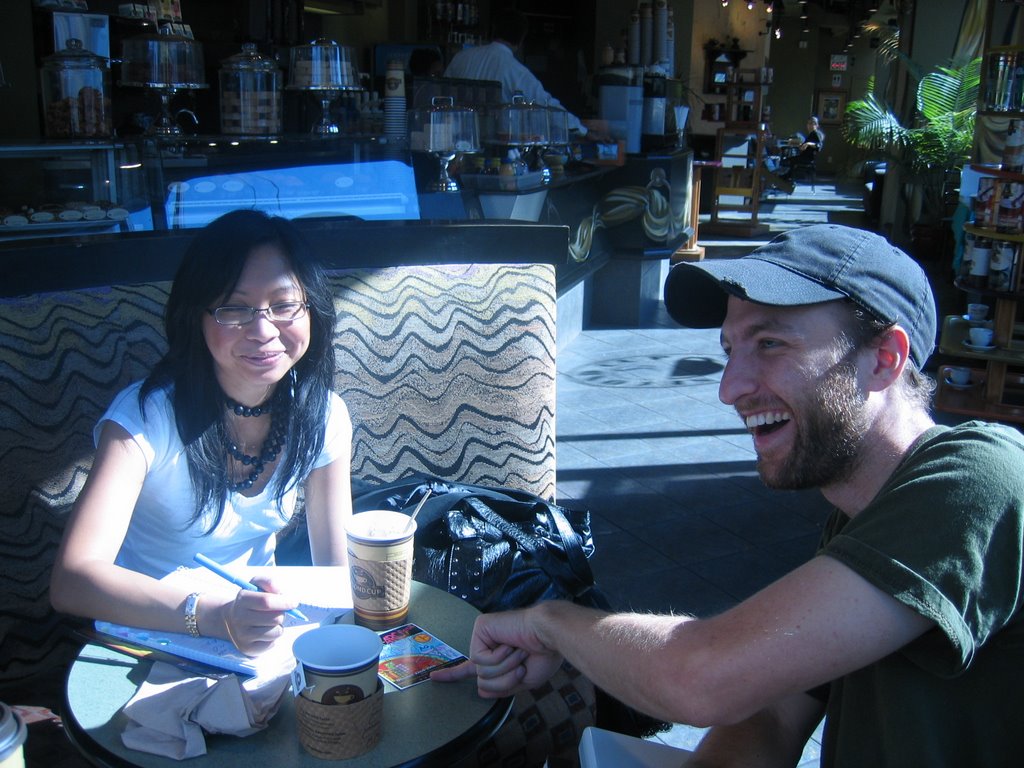
 Here is Marie in a meeting with ARCfest founder and general theatre guy extraordinaire Josh Bloch. They are pointing at the ARCfest postcard which is oh-so-snazzy. Don't you agree?
 Check out their website for all the exciting happenings!
 Here is Marie in a meeting with ARCfest founder and general theatre guy extraordinaire Josh Bloch. They are pointing at the ARCfest postcard which is oh-so-snazzy. Don't you agree?
 Check out their website for all the exciting happenings!
Theatre Creators' Reserve
Cahoots is now accepting applications for Theatre Creators’ Reserve!
Deadline: November 1, 2006
Cahoots Theatre Projects is a theatre recommender for the Theatre Creators’ Reserve. This program allows Ontario artists time and support to work on new creations by applying to theatre companies who in turn recommend funding from the Ontario Arts Council. Please consult the OAC's information page for more details.
For the 2005-2006 season, Cahoots was pleased to recommend funding to the following artists:
Byron Abalos – Brown Balls
Camellia Koo – non-perishable
Soraya Peerbaye – tell
Bea Pizano – The Communion
Michael Rubenfeld and The Suck and Blow Collective – Suck and Blow
Guillermo Verdecchia – Secure
Artists interested in applying for this year's program are asked to review the Cahoots’ mandate. In keeping with our mandate, preference will be given to artists that reflect Cahoots’ core beliefs and values. Cahoots strongly encourages submissions from artists working in non-text disciplines, or with diversity of practices and approach.
To apply, please prepare the following:
1. Vision – your letter or statement of intent, including any previous development
2. Project – a proposal and/or script excerpt
3. Bio/Resume
4. Support – video/audio for non-text based submissions only (VHS or any standard digital formats)
5. OAC forms – 3 copies of the form available on their site.
6. SASE – with enough postage to cover the material you wish returned
(Please note there is a 40 - page limit to the entire application.)
Send by mail or drop off to:
Cahoots Theatre Projects
174 Spadina Ave. #610
Toronto, Ontario
M5T 2C2
RE: THEATRE CREATORS' RESERVE
Recommendations will be determined based on the following factors:
scope and scale of the proposed project
artists’ past history of creation
feasibility of the artists’ workplan
Any questions regarding the program, please contact Marjorie or by phone at 416-203-9000 x3.
literary lights
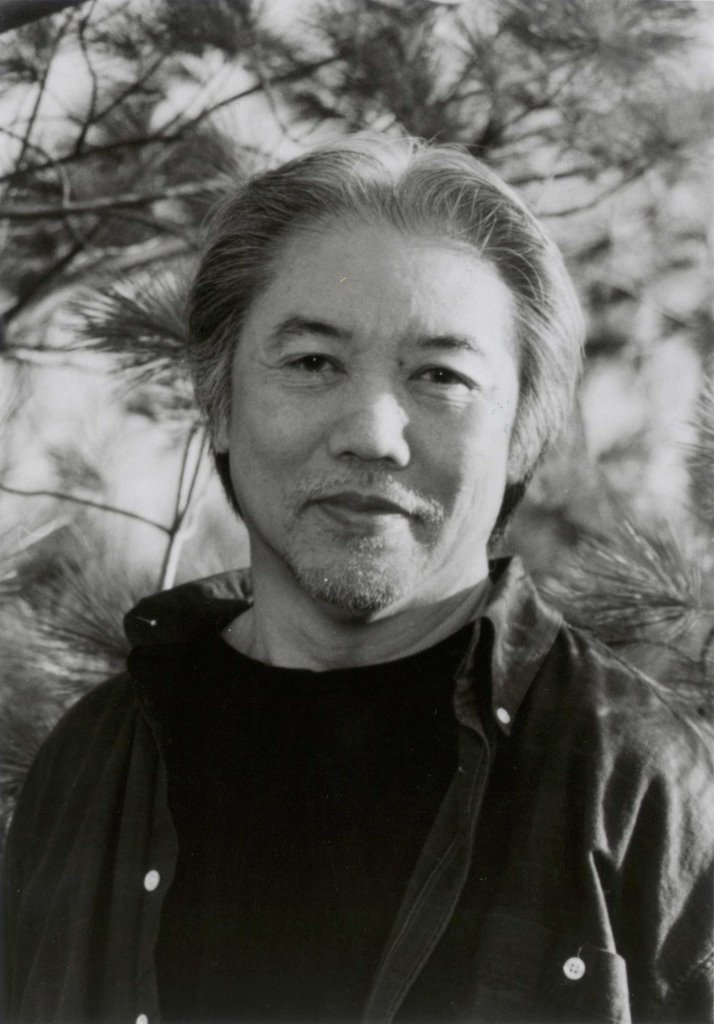
Cahoots Theatre Projects' honourary chair Wayson Choy (All That Matters) joins an exciting line up of authors reading from new works in progress:
Nigerian Nobel laureate Wole Soyinka
Azar Nafisi (Lolita In Tehran)
Miriam Toews (A Complicated Kindness)
MG Vassanji (The In-Between World of Vikram Lal)
Ann-Marie MacDonald hosts.
Called Uncensored, the gala benefit isfor PEN Canada, an association of
writers and supporters formed in 1926 to defend freedom of expression. It's part of the International Festival Of Authors running Wed, Oct 18 to 28 at Harbourfront in Toronto.
Tickets for readings: $20 & $35.
Gala tickets: $175.
7pm readings; 8:30pm
cocktail reception with authors and live auction.
Friday, October 20.
Convocation Hall.
31 Kings College Circle. Call (416) 978-8849.
For more info, go to PEN Canada.
Tuesday, October 03, 2006
i like my actors organic
ORGANIC ACTOR
Acting workshop
Led by Victor Mora
In this workshop the doers develop the essential elements of organicity that will give them the opportunity to confront themselves with their body-life in the present-moment. Having unblocked the body, the flow of emotions and feelings are organically free. Victor Mora has been a professional working actor, director and acting teacher for 25 years. He has trained with Vladimir Pechkine (Russia) Augusto Boal (Brazil) Pina Bausch (German)Stanislaw Scierski (From Jersy Grotowski’s Theatre Company) Miguel Ponce (Cuba-Venezuela)
CONTENT
Physical exercises
Psycho-Physical exercises
Vocal resonators
Improvisations
Physical actions system (Stanislavski-Grotowski)
BRING LOOSE CLOTHING
WHEN: October 10 to October 26 /2006 (6 classes)
Tuesdays and Thursdays 5:00 pm to 7:00 pm
WHERE: Studio 145. 1173 Dundas St East at Carlaw
(From Pape station takes bus 72 southbound to Dundas st east)
FREE PARKING
Cost: 100.00
To register: (416) 6546276 or azuldot@hotmail.com
Acting workshop
Led by Victor Mora
In this workshop the doers develop the essential elements of organicity that will give them the opportunity to confront themselves with their body-life in the present-moment. Having unblocked the body, the flow of emotions and feelings are organically free. Victor Mora has been a professional working actor, director and acting teacher for 25 years. He has trained with Vladimir Pechkine (Russia) Augusto Boal (Brazil) Pina Bausch (German)Stanislaw Scierski (From Jersy Grotowski’s Theatre Company) Miguel Ponce (Cuba-Venezuela)
CONTENT
Physical exercises
Psycho-Physical exercises
Vocal resonators
Improvisations
Physical actions system (Stanislavski-Grotowski)
BRING LOOSE CLOTHING
WHEN: October 10 to October 26 /2006 (6 classes)
Tuesdays and Thursdays 5:00 pm to 7:00 pm
WHERE: Studio 145. 1173 Dundas St East at Carlaw
(From Pape station takes bus 72 southbound to Dundas st east)
FREE PARKING
Cost: 100.00
To register: (416) 6546276 or azuldot@hotmail.com
f.o.o.t papers?
2007 Festival of Original Theatre: Dissolving Borders
Graduate Centre for Study of Drama,
University of Toronto
February 15-18, 2007
Graduate Centre for Study of Drama,
University of Toronto
February 15-18, 2007
We invite papers and artistic presentations that examine themes surrounding intercultural performance for the 2007 Festival Of Original Theatre: Dissolving Borders. This conference and performance based festival sets out to interrogate the concept of intercultural performance by creating a forum for discussion between theatre practitioners and the academic community while addressing the ever- expanding definition of culture and the question of what constitutes a cultural group in theatre.
Topics may include, but are not limited to:
Intercultural performance in Canada.
Defining Culture: What constitutes a cultural group in theatre.
Case Studies on Intercultral theatrical process and the performance of difference.
Multi versus (or in relation to) Inter culturalism- as well as issues of intra and trans culturalism.
The constructions and contestations of difference in theatre/ performance.
Borders/ liminal spaces in intercultural theatre.
Pedagogical/ practical strategies for considering cultural plurality and understanding diversity.
The Dissolving Borders conference and festival provides a forum for scholars and artists to engage in discussion through papers, performances, talk -backs and panels. We encourage submissions from graduate students.
If you are interested in proposing a paper or presentation please send a 200-250 word abstract by October 24, 2006.
Submissions may be sent by
e-mail to: foot.graddrama@utoronto.ca
mail: 2007 Festival of Original Theatre: Dissolving Borders
Graduate Centre for Study of Drama
University of Toronto
214 College St.
Toronto, ON
M5T 2Z9
Subscribe to:
Posts (Atom)

 Posts
Posts


